Last updated: November 2026
One of the most common sizing mistakes is also one of the simplest. Someone grabs an old box and measures the outside, or measures the bottle without its pump, then sends those numbers in. The new boxes arrive, and the product won't go in.
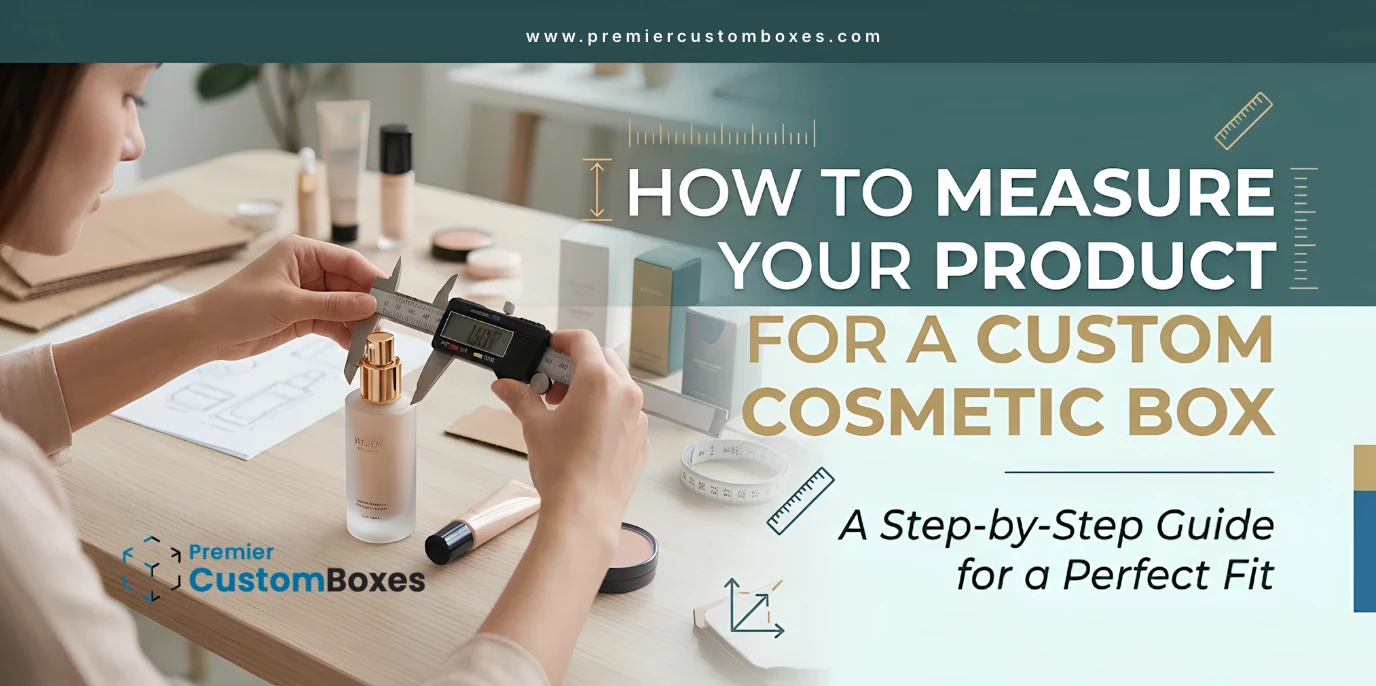
The fix is to measure the product itself, in the position it will sit, add a small gap and order by the box's inside size. That's the core of how to measure product for custom box orders. Below, you'll find each step for bottles, jars, tubes and palettes, along with the "why" behind it. We also cover the label and shipping checks that are easy to miss.
Quick answer: how do you measure a product for a custom box?
Place your product on a flat surface in the position it will sit in the box. Measure the length, width and height at the widest and tallest points, including any cap, pump or dropper. Measure a few units and keep the largest numbers. Add a small gap for fit, then order by inside dimensions in L x W x H.
| What you need | Time | Result |
|---|---|---|
| Your product (a few units), a ruler or calipers, a flat table, paper and pen | A few minutes per product | Inside box dimensions you can send for a quote |
Key takeaways
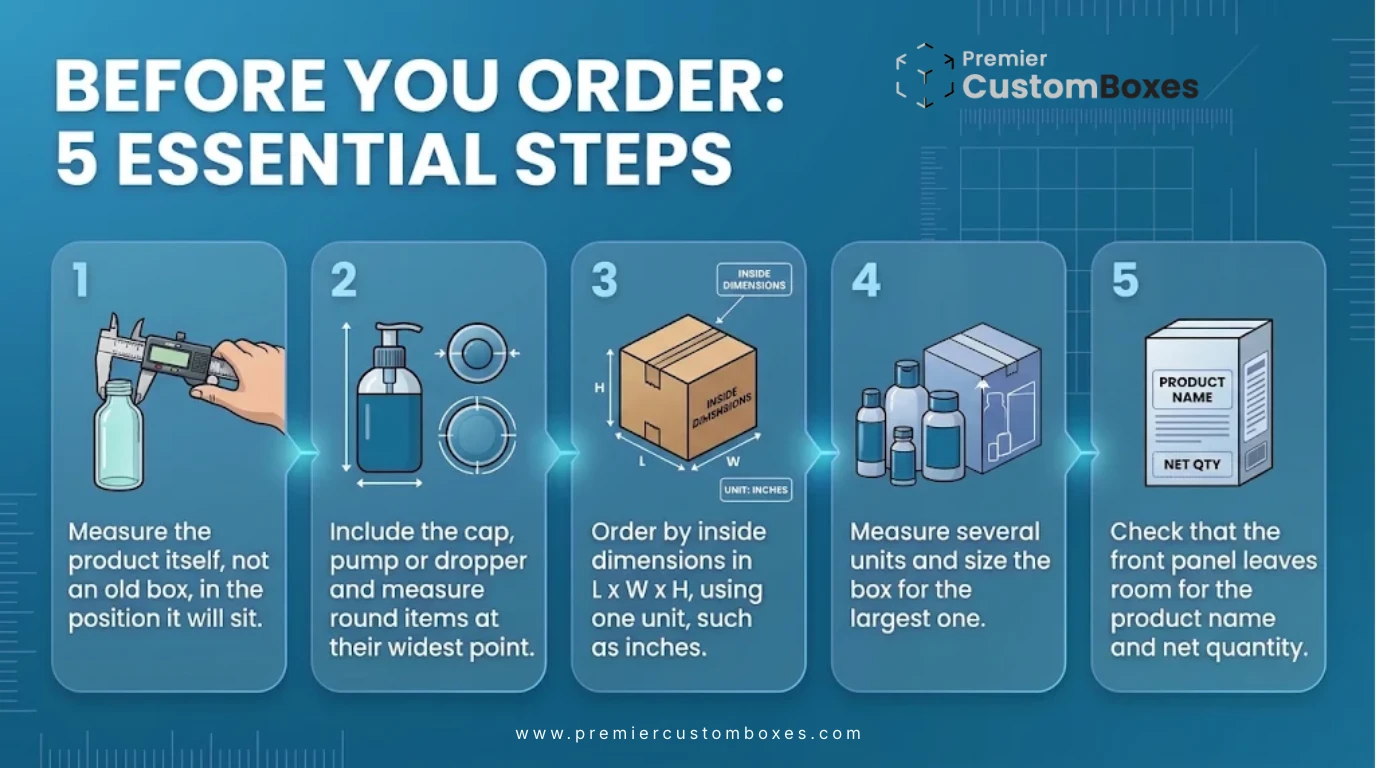
- Measure the product, not an old box.
- Include caps, pumps and droppers. Measure round items at their widest point.
- Write sizes as inside dimensions, in L x W x H, in one unit.
- Size for the largest unit you measured.
- Check that the front panel leaves room for required label text.
What tools do you need to measure a cosmetic product?
For most products, a good ruler and a flat surface will do the job. Small round items, like lipstick tubes or dropper bottles, are easier to measure well with a caliper.
- Ruler or tape measure: Fine for palettes and larger jars. A metal ruler beats a soft tape because it stays straight.
- Caliper: A small tool with two jaws that close on the item. It reads widths and diameters very precisely. Diameter is the distance straight across a round item at its widest point.
- Flat surface: A table or countertop. If the product rocks or tilts, your height reading will be off.
- A straight edge: A book or ruler laid across the top of the product. It marks exactly where the tallest point is.
Pick one unit and stick with it. Most US brands use inches. If your bottle supplier lists sizes in millimeters, convert everything to inches or keep it all in millimeters. Mixing the two on one form is an easy way to end up with the wrong box, much like a recipe that switches between cups and grams halfway through.
What to remember before you order
How to measure your product for a custom box, step by step
Work through these steps in order. Each one prevents a fit problem that would otherwise show up after printing, when it's too late to fix.
Step 1: Decide how the product will sit in the box
Choose the position before you measure anything. A bottle standing up gives its full height as the box height. Lay that same bottle down, and its diameter becomes the height instead.
Why it matters: it works like a book on a shelf. Standing up, it needs a tall shelf. Lying flat, it needs a deep one. Most bottles, jars and tubes sit upright in cosmetic retail boxes, so measure them that way unless you plan something different.
Step 2: Measure length and width (or diameter)
For square or rectangular items, like palettes and compacts, measure the longest side across the top. That's the length. Give the product a quarter turn and measure the shorter side. That's the width.
For round items, measure the diameter at the widest point, which is often not the middle. A jar's lid can be wider than the jar itself. A bottle can have a wide base or a rounded shoulder (the curved part near the top). The widest diameter becomes both the length and the width of a square box.
Why it matters: a doorway has to clear your shoulders, not your waist. The box opening works the same way. It has to clear the widest part of the product.
Step 3: Measure the full height with the cap, pump or dropper on
Stand the product upright, lay a straight edge across the top and measure from the table to that edge. Always keep the closure on. A pump, dropper bulb or tall cap adds height, and it's an easy part to forget. For squeeze tubes, measure to the end of the crimp, which is the flat, sealed strip at the bottom of the tube.
Why it matters: if you measure your height for a doorway, you'd count the hat you'll be wearing. The cap rides along in the box, so it counts too.
Step 4: Use the imaginary box method for odd shapes
For irregular items, like a curved perfume bottle or a lash case with a hinge, picture the smallest rectangular box the item could fit into. Measure its longest, widest and tallest points, even if they sit in different places on the item. Carriers use this same method for odd-shaped parcels, as the UPS guide to measuring packages and dimensional weight shows.
Step 5: Measure several units and keep the largest
Measure each side at least twice. Then measure a few units from the same batch, because bottles, jars and caps can vary slightly from one to the next. Record the largest number for each side.
Why it matters: if one of your feet is a little bigger, you buy shoes for that foot. A box sized for your smallest bottle may pinch the biggest one.
Step 6: Add room for inserts, tissue or extra items
An insert is a cut piece of paperboard or another material that holds the product still. It takes up space, so the box must be big enough for both. The same goes for tissue paper, a leaflet or a second product in a set. Measure everything that goes in the box, not only the main item.
Step 7: Write it as inside dimensions, L x W x H
Write your final numbers as length x width x height, add the unit and label them "inside." The format looks like this: "inside L x W x H in," with your own numbers in place of the letters. That one word, "inside," clears up a lot of back-and-forth before it starts.
A worked example: a dropper bottle
Say you sell a serum in a dropper bottle. You stand five bottles upright and measure each one with the dropper on. You write down the widest diameter and the tallest height for every bottle, then keep the biggest of each.
The diameter becomes both your length and width, and the height stays the height. You send those numbers to our team, note that you want a tuck end box, and ask us to add the right gap for that style. Your final inside size depends on the box style and material, which the next sections explain.
What are length, width and height on a box?
Length and width describe the opening of the box. Length is the longer side of the opening, and width is the shorter side. Height, also called depth, runs from the inside bottom to the top edge.
The standard order is always L x W x H. Swap the numbers, and the opening can end up on the wrong side. Picture a bottle box that opens along its long side, like a shoe box, instead of at the top. This matters a lot for a tuck end box, which is a folding carton with flaps that tuck in at the top and bottom. It's a common style for lipstick, serum and cream boxes, and its flaps sit on the L x W ends.
Inside vs outside box dimensions: which one do you order by?
Order by inside dimensions. Box makers quote and build from the inside size, because that's the space your product needs. The outside size adds the thickness of the walls, and that's the number carriers and store shelves care about.
A suitcase is a good comparison. You care about what fits inside it. The airline cares about the outside, because that's what has to fit in the overhead bin.
| Inside dimensions | Outside dimensions | |
|---|---|---|
| What it measures | The empty space where the product sits | The whole box, walls included |
| Who uses it | Box makers, for quotes and dielines | Carriers, retailers, warehouses |
| Folding carton (thin paperboard) | Close to the outside size | Only a little bigger than inside |
| Rigid box (thick board) | Noticeably smaller than outside | Bigger, because the walls are thick |
Board thickness explains the gap. A rigid box is a thick, sturdy box that doesn't fold flat. Its walls are much thicker than a folding carton's and are often wrapped in printed paper, so the difference between inside and outside is larger. If you're planning a premium set, our post on mistakes to avoid when making rigid boxes covers more fit issues.
How to measure a cosmetic box you already have
If you're copying a box you already use, measure the inside, wall to wall, not the outside. Open it, measure the opening across both sides, then measure from the inside bottom to the top edge. Be careful if your old box was already tight, because copying it copies the problem.
How much extra room should you add around your product?
Add a small gap so the product slides in and out easily without rattling. That gap is called clearance. A good fit feels like a glove: snug, but you can still pull your hand out. There's no single right number, because it depends on the box style, the material and whether you use an insert.
- Folding cartons usually need only a slim gap, because the thin walls flex a little.
- Rigid boxes don't flex. With too little room, they're hard to close. With too much, the product slides around.
- Inserts hold the product, so the outer box is sized around the insert, not the bare product.
- Fragile glass or items that ship by mail may need more room for padding.
You'll see different clearance numbers from different suppliers, and that's normal, since each one builds boxes a slightly different way. Our honest advice is to send your exact product size and let our packaging team add the right gap for the style and material you choose. It's safer than guessing.
What are typical cosmetic box dimensions?
Typical cosmetic box dimensions depend on the container, not the product category. Two "1 oz" bottles from different suppliers can have very different shapes. Use the table below to see what to measure for each type, then measure your own product.
| Product | What to measure | Where fit goes wrong | Common box style |
|---|---|---|---|
| Lipstick tube | Diameter of the case, height with cap on | Cap wider than the base | Tuck end box |
| Serum or dropper bottle | Widest diameter, height with dropper bulb | Dropper left off when measuring | Tuck end box, sometimes with an insert |
| Foundation bottle with pump | Base width, height with pump | Pump nozzle sticking out sideways | custom foundation boxes |
| Cream jar | Lid diameter (often the widest part), height with lid | Measuring the jar, not the lid | custom cream boxes |
| Perfume bottle | Imaginary box around the bottle and cap | Curved shapes measured at the middle | Rigid box or folding carton with an insert |
| Palette or lash case | Length, width and closed thickness, including the hinge | Thickness measured when open | custom eyelash boxes or a sleeve |
Why travel and tester sizes need their own measurements
Smaller sizes are rarely a shrunk copy of the full-size container. A travel jar often has a lid nearly as tall as the full-size one, so a jar with a quarter of the product doesn't need a quarter-size box. Measure every size you sell instead of scaling down from the big box.
Does your box size leave room for required labels?
Check this before you lock in a size. A box can fit the product perfectly and still be too small for the text you need to print on it.
The principal display panel (PDP) is the front panel shoppers are most likely to see on the shelf. Under the 21 CFR Part 701 rules on cosmetic labeling, the net quantity of contents goes in the bottom 30 percent of that panel. Net quantity means how much product is inside, such as fl oz. The FDA summary of cosmetics labeling requirements also says the front panel should show the product name and what the product is or does.
These rules apply to the outer carton, not only the bottle inside it. Ingredients can go on an information panel, which is a side or back panel of the carton. On a slim lipstick or serum box, those panels are small. If your text won't fit at a readable size, a slightly wider box may be the better choice.
Rules differ by state and product type; check your local regulations. We can help you plan space for required labels, but your brand is responsible for the label content.
How does box size affect shipping?
Carriers use the outside size of the shipping box, not the inside. They may bill by dimensional (DIM) weight, which is a price based on a package's size as well as its weight.
UPS works out DIM weight by multiplying length x width x height and dividing the result by a set number. It measures the longest side first and rounds each measurement up to the next whole inch. That means a box a few tenths of an inch bigger than it needs to be can be billed as a bigger box. Carrier rules change, so check your carrier's current page before you plan mailers.
What are the most common measuring mistakes?
Most fit problems come from a handful of small slips. Here they are, with the fix for each.
| Mistake | What happens | Fix |
|---|---|---|
| No unit written | Inches get read as millimeters, or the other way | Write "in" after every number |
| Not saying inside or outside | Box comes out too small or too big | Label sizes "inside" |
| Cap, pump or dropper left off | Lid won't close | Measure with the closure on |
| Only one unit measured | Some bottles pinch or won't fit | Measure several units, keep the largest |
| Insert thickness ignored | Product plus insert won't fit | Size the box around the insert |
| Flat box blank measured | Numbers don't match the real cavity | Measure the product, or an assembled box from the inside |
| Length and width swapped | Opening on the wrong side | Length is the longer side of the opening |
| Copying an old, tight box | The same bad fit, again | Start from the product |
| Bottle or cap supplier changes later | New parts don't fit old boxes | Confirm final components before ordering |
Pro tips from our team
- Take a photo with a ruler. Place the product next to a ruler and photograph it from the front and the side. Photos help our team spot odd shapes that numbers alone can hide.
- Test-fit with paper. A dieline is a flat outline of the box with its cut and fold lines. Print it on paper at full size, cut it out and fold it. It's a cheap way to catch problems before printing.
- Check the proof carefully. Look at sizes and panel space, not only colors.
- Share only what's needed. If your product hasn't launched yet, send sizes and plain photos. You don't have to share formulas or unreleased artwork just to size a box.
How do you send your measurements to Premier Custom Boxes?
Copy the list below, fill it in and send it with your quote request. It gives our team what we need to price and plan your box.
- Product: name and container type (bottle, jar, tube, palette)
- Inside size: L x W x H, with unit (inches)
- Position: standing or lying down
- Quantity: how many boxes
- Box style: tuck end, rigid, magnetic lid, sleeve, or "not sure"
- Material: cardboard, kraft, corrugated, rigid, or "not sure"
- Finish: matte, gloss, soft-touch, foil, embossing, spot UV, window
- Insert: yes or no, and what it holds
Spot UV is a glossy coating applied to just one area of the box, such as your logo. Not sure which style, material or finish fits your product? That's fine. Our packaging team can recommend options, and we can make any size or shape on request.
You get free design support with unlimited revisions, free CAD templates and free proofing before printing. A CAD template is a flat, computer-drawn layout of your exact box size, ready for artwork. Orders start at 100 boxes and ship free to all 50 states. Standard turnaround is 10–12 business days, and rush service ships within a week. See our custom cosmetic boxes for styles and ideas.
Frequently Asked Questions
How do I measure my product for a custom box?
Measure the product's length, width and height at its widest and tallest points, in the position it will sit. Include caps and pumps, measure a few units, keep the largest numbers and send them as inside dimensions.
Do I use inside or outside dimensions for a custom box?
Use inside dimensions. That's the space your product needs, and it's how box makers quote and build. Outside size matters mostly for shipping and shelf space.
What order do box dimensions go in (L x W x H)?
The order is length x width x height. Length is the longer side of the opening, width is the shorter side, and height is the depth from the inside bottom to the top edge.
How much extra room should I add around my product?
Add only a small gap, and let your box maker set the exact amount. The right clearance changes with the box style, material and insert, so send your exact product size and ask our team to confirm.
How do I measure a round bottle or jar for a box?
Measure the diameter at the widest point, which is often the lid, base or shoulder. Then measure the full height with the lid on. The diameter becomes both the length and the width of the box.
Should I include the cap, pump or dropper when measuring?
Yes, always. These parts add height, and leaving them off is one of the most common reasons a lid won't close.
What size box fits a 30 ml (1 oz) dropper bottle?
It depends on your exact bottle, because 30 ml bottles come in many shapes and heights. Measure your bottle's widest diameter and its height with the dropper on, then send those numbers to our team for a matching inside size.
Get a free quote
A box that fits starts with three numbers you can measure today. Send us your inside size, quantity and preferred style, and our packaging team will reply with a clear quote and a free design mockup. You also get free design support, free shipping across the USA and a low minimum of 100 boxes. Get a free quote by calling (800) 844-1443 or emailing justin@premiercustomboxes.com.