

Last updated: November 2026
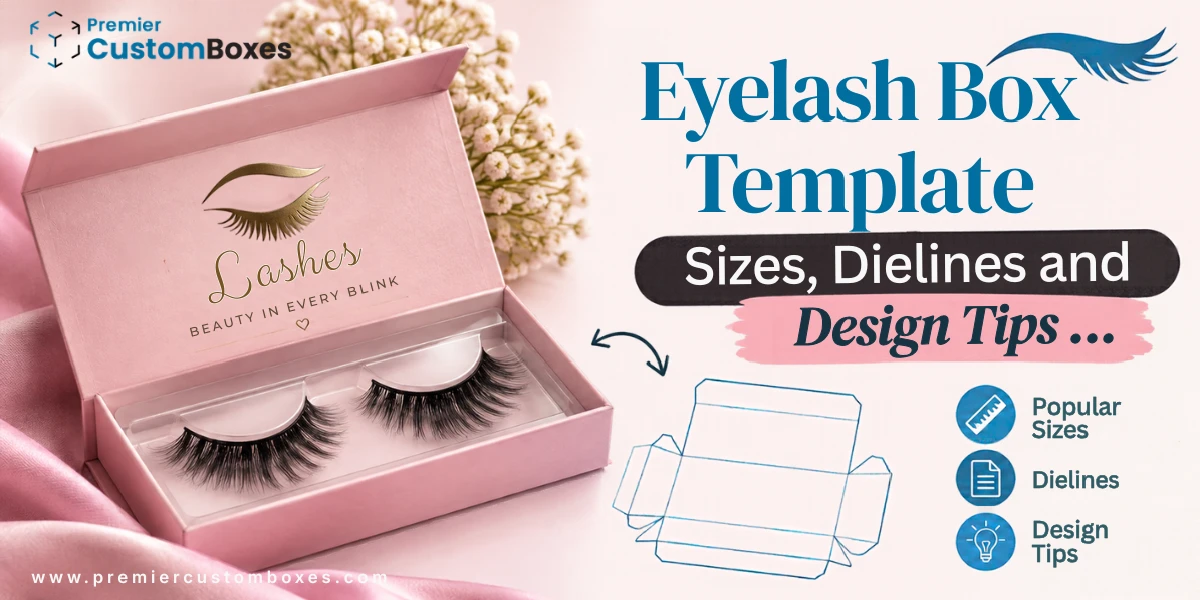
The safest eyelash box template is the dieline your printer builds from your own lash tray size. A free download or home-print file is fine for a mockup. But a box drawn for someone else's tray is a common reason lash boxes arrive too tight, too loose or bent out of shape.
Getting the template right the first time means you only pay once. A reprint costs money and time, and a box that crushes your lashes can cost you customers. Below, we answer the questions lash brand owners ask us most, one at a time and in plain words.
Key takeaways
- No official standard lash box size exists. Measure your tray and build the box around it.
- Etsy and Canva templates are made for home printers. Factory printing needs the printer's own dieline.
- Keep text, logos and windows away from fold lines, and run your background color past the cut line (bleed).
- In the US, the front of the box should show the product name, what it is and an accurate count of lash pairs.
- Always check a proof before you approve a print run.
Eyelash Box Template: What's the Quick Answer?
An eyelash box template is a flat outline of your box that shows where it gets cut, folded and glued. Before you design on one, confirm three things: your lash tray size, the box style you want, and whether the file came from the company that will print it. When all three match, you've removed the biggest risks before you spend a dollar on printing.
Here are short answers to the questions we hear most often:
| Question | Short answer |
|---|---|
| Is there a standard lash box size? | No. Sizes vary by tray and lash style. Measure your tray first. |
| What is a dieline? | The flat, unfolded shape of the box, with cut, fold and glue lines. |
| Can I print from an Etsy or Canva template? | Fine for home crafts and mockups. Use the printer's dieline for factory runs. |
| What file should I send? | A vector file, usually AI or print-ready PDF, in CMYK color. |
| How much bleed? | Follow the bleed area marked on your printer's dieline. |
| What goes on the front in the US? | Product name, what it is, and the net count of lash pairs. |
| Do I need an insert? | Usually yes. A tray keeps lashes flat and stops them from bending. |
What Is an Eyelash Box Dieline and How Does It Work?
An eyelash packaging dieline is a drawing of your box laid out flat, like a cereal box you've opened up and pressed flat on a table. It tells the factory where to cut and fold. It also shows you exactly where your artwork will land once the box is folded.
What do the different lines on a dieline mean?
Each line has one job. Most dielines use a different color or dash style for each, so you can tell them apart at a glance.
- Cut line: the outside edge. The machine cuts the box out of the sheet here.
- Fold line (crease line): where the board bends to form the box sides.
- Glue flap: a small tab that gets glued to hold the box together. Any art on it stays hidden.
- Bleed: extra color that runs past the cut line. If the cut shifts slightly, you won't see a thin white edge.
- Safe zone: an inner margin. Keep text and logos inside it so nothing gets trimmed or folded over.
Is a template the same as a dieline or a mockup?
Not quite, although people often mix the words up. The dieline is the outline itself. A template is a ready-made file with that dieline on it, so you can place your design on top.
A mockup is a picture of the finished, folded box with your art on it. It helps you judge the look, but nobody prints from it.
What to Know Before You Design
What Size Is a Normal Lash Box?
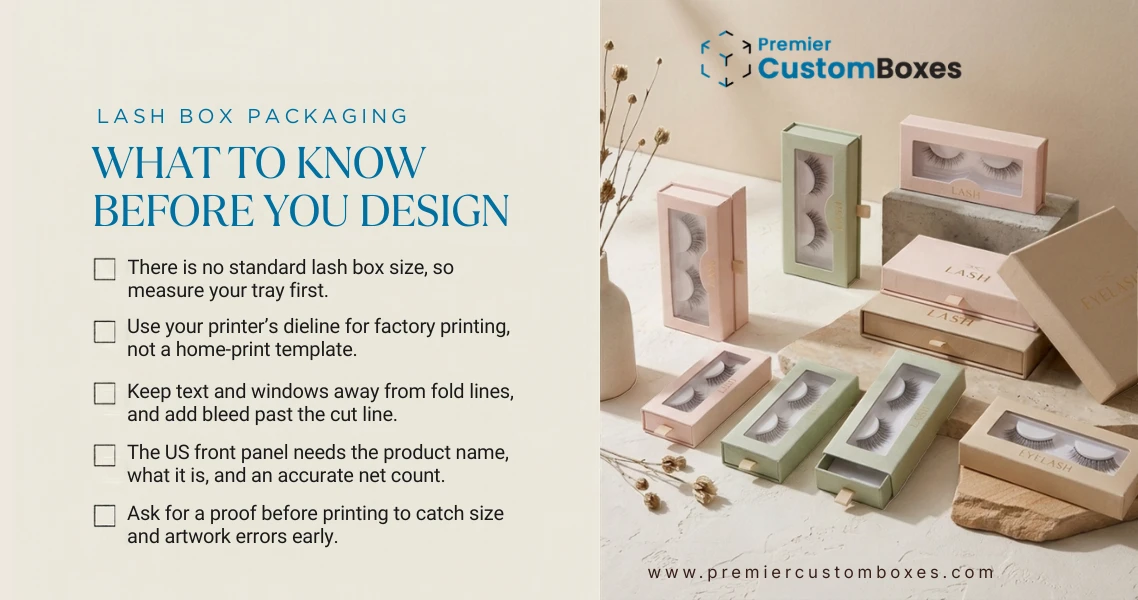
There's no official standard size for a false eyelash box, so the right size is the one that fits your tray. Most single-pair boxes are small, slim rectangles. Exact lash box dimensions change with the tray, the lash length and the box style.
How big is an eyelash box, as a real example?
Most single-pair boxes are only a few inches long and well under an inch deep. For example, one paper lash box sold on Amazon measures about 4.29 x 2.08 x 0.55 inches.
Treat that as one example, not a rule. Your tray may be longer, wider or deeper. On a box this small, even a slightly wrong size can let lashes slide around or press the band out of shape.
How do I measure my lash tray for the right box?
Measure the tray, not just the lashes, and use inches. Here's the order we suggest:
- Put one pair of lashes in its tray, exactly as you'll sell it.
- Measure the tray's length and width at the widest points.
- Check whether the longest lash fibers stick out past the tray. If they do, measure to the fiber tips.
- Measure the tray's height, including any clear lid or cover.
- Allow a little extra room so the tray slides in without force. The board's own thickness also takes up space inside.
- Send these numbers and a photo of the tray to your printer, and ask them to build the dieline from your sizes.
Our advice: send a physical tray if you can. Hand measurements are easy to get slightly wrong, and a real tray lets the printer check the fit for you.
Does the size change for a single pair, multi-pack or lash kit?
Yes, and the box style often changes too. A single pair suits a slim box. A multi-pack or flip-book box needs room for several trays, either side by side or stacked.
A lash kit with glue and an applicator usually needs a deeper box. Its insert should give each item its own space. For example, a kit with two lash pairs and a glue tube needs all three items measured, not just the lashes.
Which Eyelash Box Style Should You Choose?
For most new lash brands, a folding box with a window is the safe first choice. It's light, ships flat and shows off the lashes. Rigid magnetic boxes make more sense for premium sets and gifts.
How do the main lash box styles compare?
Each style trades cost against protection and feel. A folding carton is a thin paperboard box that ships flat. A tuck end box is a folding carton whose top and bottom flaps tuck in. A rigid box is a thick, sturdy box that doesn't fold flat.
| Style | Protection | Cost level | Look and feel | Best for |
|---|---|---|---|---|
| Tuck end folding carton | Good for light items | Lower | Clean, simple | Single pairs, starter lines |
| Window box | Good with an insert | Lower to medium | Shows the lashes | Retail shelves |
| Sleeve and tray | Good | Medium | Neat slide-out opening | Gift sets, subscription boxes |
| Drawer box | Good | Medium | Fun pull-out reveal | Multi-packs |
| Magnetic rigid box | Highest | Higher | Heavy, premium | Lash kits, luxury lines, PR boxes |
If you're leaning toward rigid boxes, read our post on mistakes to avoid when making rigid boxes first. For thinner boxes, see how folding cartons can catch a shopper's eye.
What about diamond, oval and flip-book shapes?
These are custom die-cut shapes. That means they're cut with a tool made to match your design. Diamond and oval boxes stand out on a shelf, and flip-book boxes open like a small book to hold several pairs.
They look great, but each one needs a dieline drawn for that exact shape and tray. A rectangle template won't work, so ask for the right file before you start your artwork.
Where should the window cutout go?
Put the window on a flat panel, centered over the lashes, and keep it clear of every fold line. A window that crosses a fold weakens the box and can tear.
Rectangles, circles, hearts and curves all work, so pick a shape that suits your brand. A clear plastic sheet behind the window keeps dust out while shoppers can still see the lashes.
Do I need an insert or tray inside a lash box?
In most cases, yes. An insert is a holder inside the box, often clear plastic, that keeps lashes flat and in place. Without one, lashes can shift and bend during shipping. Since the box is built around the insert, choose the insert first.
Can I Use a Canva or Etsy Template for Professional Printing?
Use them for home crafts and early mockups, not for factory runs. Many of these files are sold as letter-size sheets for a home printer or a home cutting machine. They won't match a factory's cutting tool or your exact tray.
How does a DIY template compare with a printer's dieline?
| Point | DIY lash box template (Etsy, Canva) | Printer's dieline |
|---|---|---|
| Fit | Built for a general tray | Built from your tray sizes |
| File types | Often SVG, PNG, PSD, Canva | Usually AI or PDF vector |
| Print quality | Home printer on cardstock | Offset or digital press |
| Proofing | None | Checked before printing |
| Best use | Tests, mockups, small craft batches | Retail and wholesale orders |
When is a DIY template fine?
A DIY template works well when you want to test a look, hand-make a few boxes for a market stall, or show a design idea to a printer. It's cheap and quick. Just don't send it to a factory and expect it to fit their machines.
When should I use the printer's dieline?
Use it every time you order printed boxes. The printer's file matches their cutting tool, board thickness and glue flap. At Premier Custom Boxes, we start from your measurements and supply a free CAD template, so your art and the box line up.
How Do You Design Artwork on a Lash Box Dieline?
Start with the printer's dieline and put your art on a separate layer. Add bleed, keep text inside the safe zone, then send a vector file in CMYK and check the proof.
What are the steps to set up my artwork?
- Get the dieline from your printer, built to your tray size.
- Open it in a design program such as Adobe Illustrator, and lock the dieline on its own layer.
- Create a new layer for your artwork. Never draw on the dieline layer.
- Extend background colors and images into the bleed area.
- Place your logo and text inside the safe zone, away from folds and the glue flap.
- Check which panel faces the shopper, and put your brand name there.
- Turn fonts into outlines so they can't change on another computer.
- Export and send the file, then review the proof slowly, panel by panel.
What file format do I need to send to a box printer?
Send a vector file, usually AI (Adobe Illustrator) or a print-ready PDF. Vector art is built from lines and stays sharp at any size. Raster art, like PNG or JPG images, is built from pixels and blurs when enlarged.
SVG and DXF files carry cutting lines and suit craft cutters, while PSD is a Photoshop file. If all you have is a Canva design or a PNG logo, don't worry. Our design team can help rebuild it.
How much bleed should I add?
Add the bleed shown on your printer's dieline. Bleed sizes differ between printers, so don't copy a number from another template. If the file doesn't mark it, ask before you design.
Why do printed colors look different from my screen?
Screens make color with RGB light, but most boxes are printed with CMYK inks (cyan, magenta, yellow and black). Some bright screen colors can't be matched exactly in CMYK. Set your file to CMYK from the start, so the proof doesn't surprise you.
If your brand relies on one exact color, tell our team early. We'll point it out on the proof so you can judge it before anything is printed.
The printing method matters too. Offset printing uses metal plates and suits larger runs. Digital printing prints straight from your file and suits smaller runs. We offer both, and our team can suggest the better fit for your quantity.
Which finishes work well on lash boxes?
Foil stamping, spot UV, embossing and gloss or matte coatings are popular choices for lash boxes. Foil adds metallic gold or silver. Spot UV is a shiny coat on chosen areas, like a logo, and embossing raises a shape so you can feel it.
In our view, one or two finishes usually look more premium than five. Each finish adds a production step, so ask how your choices affect the quote.
What Goes on the Front of an Eyelash Box in the US?
The front panel, called the principal display panel, should show the product name, what the product is, and an accurate net quantity, such as the number of lash pairs. The FDA summary of cosmetics labeling requirements explains these points and notes that the rules sit in 21 CFR 701 and 740.
Small boxes need extra care. Under 21 CFR Part 701 on cosmetic labeling, the net quantity text must be at least 1/16 inch tall when the front panel is 5 square inches or less. Measure your own front panel to see whether this applies. The same rule says that if a box has alternate front panels, the net quantity goes on each one.
Plan space for this text on your dieline early, because it's much harder to squeeze in once the design is finished. If your box also holds lash glue or another cosmetic, more labeling rules may apply. Rules differ by state and product type; check your local regulations. We design boxes with space for required labels, but we can't give legal advice about your product.
What Template Mistakes Cost Lash Brands the Most?
A wrong box size is usually the costliest mistake, because it can leave a whole run unusable. Most of the others are artwork errors, and a careful proof check catches them before printing.
- Using a home-print template for a factory order. Fix: design on the printer's dieline.
- A box that doesn't match the tray. Fix: measure the tray with lashes inside and share a sample.
- A window over a fold. Fix: keep cutouts on flat panels only.
- Low-resolution logos. Fix: use a vector logo, not a screenshot.
- Text too close to an edge or fold. Fix: keep all text inside the safe zone.
- Missing bleed. Fix: run backgrounds past the cut line.
- RGB color mode. Fix: convert to CMYK before you send files.
- No room for the net count. Fix: plan front-panel label space from day one.
How Do You Order Custom Lash Boxes from Premier Custom Boxes?
Send us your tray size, quantity and preferred style. We'll build a dieline and a quote around them, and our packaging team can help you choose the style, material and finish if you're unsure.
- Free CAD template built to your sizes, in any size, shape and material.
- Free design support with unlimited revisions, so you're never stuck fixing files alone.
- Free proofing before printing, so you see your art on the dieline before anything is made.
- Low minimum of 100 boxes, which suits new lash lines.
- 10–12 business day standard turnaround, with rush service that ships within a week.
- Free shipping to all 50 US states.
- Offset and digital printing, plus foil, embossing, spot UV, gloss and matte coatings, die-cut windows and custom inserts.
Start with our custom eyelash boxes page. If you sell other beauty products, browse our full range of custom cosmetic boxes. For shelf space in salons and stores, read about display packaging that draws shoppers in.
Frequently Asked Questions
What size is a normal lash box?
There's no single normal size, because it depends on your tray. Single-pair boxes are usually slim rectangles a few inches long. Measure your tray and ask your printer to size the box from it.
How do I make my own eyelash box template?
The simplest safe way is to send your tray measurements to your printer and let them draw the dieline. You can sketch your own in a vector program. Still, the printer's file will match their machines and board thickness.
What file format do I need to send to a box printer?
Send an AI or print-ready PDF file with vector art in CMYK. Keep the dieline on its own layer and turn fonts into outlines.
How much bleed should I add to a box template?
Use the bleed marked on your printer's dieline. If it isn't marked, ask the printer before you start designing.
Can I order a sample before a full order of custom lash boxes?
We provide a free proof before printing, so you can check your art on the dieline. If you'd like a physical sample, ask our packaging team what's possible for your box style.
What is the minimum order for custom eyelash boxes?
Our minimum order is 100 boxes. That lets you test a new lash line without ordering thousands of boxes.
Do I need an insert or tray inside a lash box?
Usually yes, because an insert keeps lashes flat and stops them from bending in transit. Pick the insert first, then size the box around it.
Ready to Start Your Lash Box?
The safe path comes down to three steps: measure your tray, design on the printer's dieline, and check the proof before you approve it. Follow them and you'll avoid most of the mistakes that lead to reprints.
When you're ready, get a free quote from Premier Custom Boxes. Tell us your box size, quantity and style, and our packaging team will send you clear pricing and a free design mockup. Request your free quote today.

