Last updated: November 2026
What are Amazon cosmetic packaging requirements? Your product must arrive new and sealed in its original packaging. It needs one scannable barcode, an identifying code such as a lot number, and a label that meets FDA rules. The box also has to survive Amazon's warehouse handling without leaking, opening or breaking.
That's a lot of rules for one small box. The good news is that most of them are solved at the artwork stage, before anything is printed. Fixing them after printing is where the time and money go.
Key takeaways
- Three rule sets apply at once: Amazon's cosmetics policy, Amazon's FBA prep rules and FDA labeling rules.
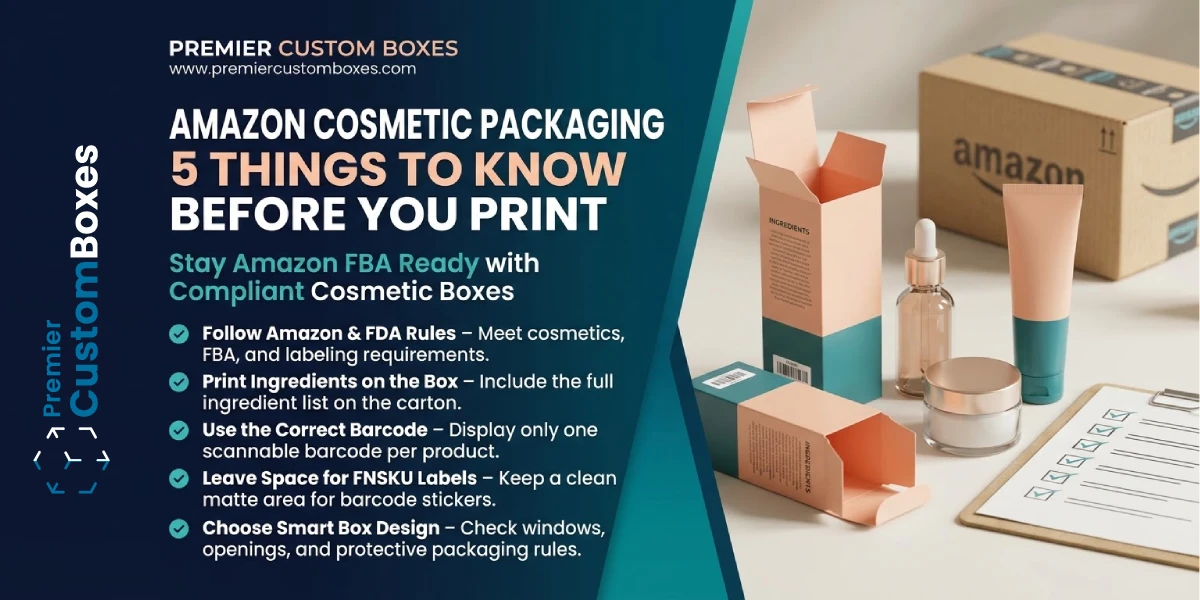
- If your cosmetic sits in a folding carton, the ingredient list must be printed on that carton.
- Only one barcode should scan on each unit. Plan where the FNSKU sticker goes before you print.
- Shiny finishes under a barcode can cause scan errors. Keep that spot matte.
- Rules differ by state and product type; check Seller Central and your local regulations.
| Quick answer | Details |
|---|---|
| What to have ready | Product sizes in inches, your label text (ingredients, net quantity, company info, US contact), barcode plan (UPC and/or FNSKU), lot code format, logo files |
| Time | Our standard box production is 10–12 business days; rush orders ship within a week. Design and proofing time depends on how quickly you approve changes. |
| Result | A sealed, labeled, protective retail box planned for FBA prep and US cosmetic labeling rules |
What are Amazon cosmetic packaging requirements?
They're a mix of three separate rule sets. Amazon's cosmetics policy covers what can be sold. Amazon's FBA prep rules cover how units are packed and labeled, and US law covers what the label must say.
Three rule sets, one box
FBA (Fulfillment by Amazon) means Amazon stores, packs and ships your products for you. Your box has to work inside its warehouses, so those rules carry real weight. Here's how the three sets split up:
- Amazon's cosmetics policy: products must be new, unused and sealed in the original manufacturer packaging. They must show an identifying code, such as a lot number, serial number or matrix code.
- FBA prep rules: units need secure packaging and a scannable barcode. Dated products also need an expiration date in a set format.
- FDA labeling rules: the label must show the product identity, net quantity, ingredients, company details and any required warnings. A newer federal law, MoCRA (Modernization of Cosmetics Regulation Act), added a contact for problem reports.
Retail box vs. shipping carton
Your retail box is the printed box a customer opens. The shipping carton is the plain corrugated (ridged cardboard) box that carries many units to Amazon. Each one follows different rules.
| Requirement | Retail box (unit) | Shipping carton |
|---|---|---|
| Product name, net quantity, ingredients | Yes | No |
| US contact for problem reports (MoCRA) | Yes | No |
| FNSKU or approved barcode | Yes, one scannable barcode | No; old barcodes on the carton must be covered |
| Lot or batch code | Yes | Helpful for your own tracking |
| Expiration date (dated products) | Yes | Yes |
| FBA Box ID label | No | Yes |
What must be printed on a cosmetic box for Amazon?
Your box needs the information US law requires on a cosmetic's outer container. The FDA summary of cosmetics labeling requirements says these rules apply to the outer container. When your product is boxed, that container is your box.
Product name and what it is
The principal display panel (PDP) is the front of the box a shopper sees first. It must name the product and show what it is, using words or a picture. "Hydrating Face Cream" works. A brand name on its own usually doesn't tell the shopper enough.
Net quantity of contents
Net quantity means how much product is inside. FDA allows weight, measure, count or a mix of these. It goes on the front panel. US labels usually show US units, such as fluid ounces or ounces.
Ingredient list on the box
New brands miss this one most often. FDA allows an off-package ingredient list only in narrow cases, and one condition is that the product is not in a folding carton. So if your lipstick or serum ships in a folding box, print the full ingredient list on that box. Most brands use INCI names, a standard naming system for cosmetic ingredients.
Business name, place and warnings
Print the name and place of business of the manufacturer, packer or distributor. Some products, such as aerosols, also need set warning statements. A product can also be both a cosmetic and a drug, such as a sunscreen moisturizer. For those, FDA says active ingredients are listed first, and other rules apply too.
MoCRA contact for problem reports
MoCRA requires a US address, US phone number or electronic contact, such as a website, on the label. Customers use it to report a bad reaction. The "responsible person" is the company legally in charge of handling those reports.
Claims to keep off the box
- Any line saying the FDA approved your product. FDA doesn't approve cosmetics before sale, so this claim misleads.
- Claims that the product fixes a medical problem. Those can turn a cosmetic into a drug in the eyes of the law.
- "Tester" or "Not for resale." Amazon expects retail-ready, sellable units.
FDA treats a cosmetic as misbranded if its label is false, misleading or missing required information. FDA: misbranded cosmetics and labeling basics covers this in more detail. Rules differ by product type, so have a regulatory advisor review your label text before you print.
What to know before you print
Does a cosmetic box need a barcode and lot number?
Yes. Each unit needs one scannable barcode, and Amazon's cosmetics policy asks for an identifying code such as a lot number. Plan the barcode and lot number on a cosmetic box early. Otherwise, you may end up with a sticker covering your ingredient list.
UPC vs. FNSKU in plain words
A UPC (or EAN outside the US) is the standard store barcode. GS1 is the group that issues them. An FNSKU is Amazon's own barcode, and it tells the warehouse which seller owns the unit. It usually starts with X00 and uses Code 128, a common barcode line pattern.
Most FBA sellers label units with the FNSKU. Some brand owners in Amazon's Brand Registry can use the manufacturer barcode instead. Your barcode setting in Seller Central decides which one applies. Amazon has also cut back its own prep and labeling services in the US, so plan to label your units yourself.
Where the FNSKU sticker goes
Amazon's FBA packaging and prep 101 post says every unit needs an accessible, scannable barcode. Only one barcode should scan. Here's our advice from the design side:
- Put the FNSKU on a flat outer face, not across a fold or a glue flap.
- Print the UPC inside a plain matte block. Size that block so the FNSKU sticker covers it fully and nothing else.
- Keep the ingredients, net quantity and MoCRA contact well away from that block.
- Leave a quiet zone. That's the empty white space around a barcode that scanners need to read it.
Label sizes depend on the sticker sheet you use, and sources quote different sizes. Check Seller Central, then measure your actual sticker before you finalize the artwork.
Lot number and expiration date
A lot or batch number shows which production run a product came from, so problems can be traced. Put it in the same spot on every box, often a flap or the bottom panel. Many brands stamp or ink-jet it after printing, so leave a clear area for it.
Amazon's prep post says expiration dates must use MM-DD-YYYY or MM-YYYY. They must appear on both the outer packaging and each unit, in 36-point font or larger. That's big text, so plan space for it on the box panel early if your product is dated.
Finishes that hurt scanning
Gloss coating, foil stamping and spot UV (a shiny coating on chosen spots) all reflect light. That reflection can stop a scanner from reading the lines. Keep the barcode area plain matte and print barcodes in black on white. Matte sticker labels help for the same reason. Our matte vs. gloss finish guide covers the look and feel side.
How to package cosmetics for Amazon FBA: step by step
Work in this order: confirm the rules, size the box, build artwork on the dieline, then test a sample before the full run. The sample is your cheapest chance to catch a problem.
Step 1: Confirm your category and hazmat status
Hazmat means items like aerosols or flammable products that need extra shipping rules. If your line includes nail polish, nail polish remover or perfume, check their status first. Amazon may ask for an SDS (safety data sheet), a document listing a product's hazards. Cosmetics made for children face extra Amazon rules too. Sort this out before you design anything.
Step 2: Measure the product in inches
Measure the length, width and height of the container, including caps and pumps. Then add room for any insert. Our guide on how to measure your product for a custom cosmetic box walks through it. A box that's too big lets the product rattle and break.
Step 3: Choose material and inserts
Glass bottles and liquids need more protection. An insert is a fitted piece inside the box that holds the product still. For example, a serum bottle in a die-cut insert can't slide into the box walls during transit. See how to choose the right cosmetic box insert. To prevent leaks, also check that caps are tight and sealed before boxing.
Step 4: Build artwork on the dieline
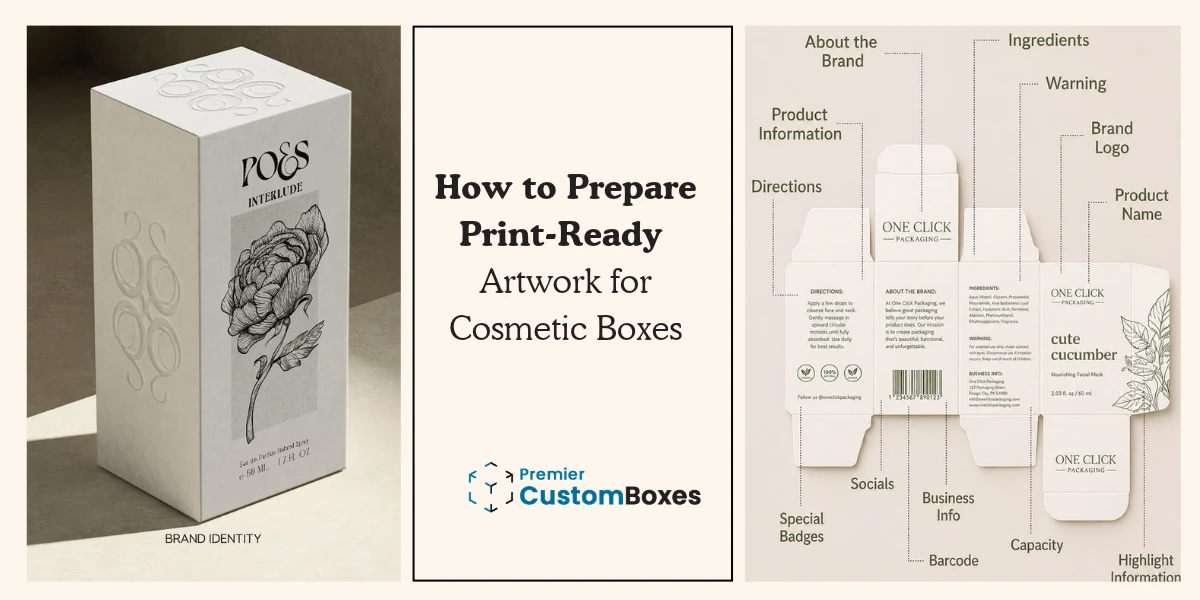
A dieline is the flat outline of your box, showing every fold and cut. Place your artwork on it in this order: barcode zone and lot code spot first, required text next, branding last. Set colors in CMYK, the four ink colors (cyan, magenta, yellow, black) used in printing. Our print-ready artwork guide has the file details.
Step 5: Proof, sample and test
Review the proof line by line. When your sample boxes arrive, print a test FNSKU label, stick it on and scan it with your phone or scanner. Then pack a few units and drop them yourself to see what holds up.
Step 6: Seal, label and bag if needed
Amazon wants units in secure six-sided boxes or properly sealed poly bags. Six-sided means fully closed: top, bottom and four sides. Boxes with perforations or openings must pass a 3-foot drop test or go in a poly bag. Amazon's prep post says openings of 5 inches or larger need a printed suffocation warning. Sources disagree on the required bag thickness, so check Seller Central for the current number.
Selling a set or bundle? Mark it clearly as a set so warehouse staff don't split it up.
Step 7: Pack the shipping carton
Pack units snugly in a corrugated shipping carton. Cover or cross out any old barcodes on the outside of the carton, as Amazon's prep post asks. Then apply the FBA Box ID label, which identifies each carton in your shipment. Size and weight limits change, so confirm them in Seller Central.
How it works: why Amazon checks all this
Amazon's warehouses rely on scanners to sort and move units. Every rule above serves one goal: a scanner reads your unit once, a picker grabs it without it opening, and the customer gets a sealed product with honest labels.
Two barcodes confuse the scanner. A loose lid can spill onto other stock. A missing lot code means a recall can't be traced. A unit that breaks the prep rules can get held up at check-in, so look up how Amazon handles non-compliant units in Seller Central. Your box is the first place to prevent these problems, which is why we ask clients to plan these details at the artwork stage.
Which box style works best for cosmetic boxes for Amazon sellers?
For most single items, a tuck end carton with an insert is the simplest choice. A tuck end box closes with flaps that tuck in at the top and bottom. Mailers and rigid boxes suit kits and premium items.
| Box style | Protection | Drop test risk | Label space | Best for |
|---|---|---|---|---|
| Tuck end carton | Good with an insert | Low if fully closed and sealed | Good on all six panels | Lipstick, mascara, single serums |
| Mailer box | Strong | Low | Large flat panels | Kits, eyelash sets, bundles |
| Sleeve over tray | Medium | Higher; the sleeve can slide off unless sealed | Limited on the sleeve | Gift-style items |
| Rigid / magnetic-lid box | Very strong | Medium; lids need a seal | Good, often on a bottom sticker or wrap | Perfume, luxury sets |
| Any style with a window | Depends on build | Higher; openings can trigger extra rules | Reduced | Products that sell on looks |
Our honest view: windows look great on a store shelf but add risk for FBA. Check Amazon's current rules on openings before you add one. For product-specific options, browse our custom cosmetic boxes, cream boxes for jars and tubes, or eyelash boxes for lash kits.
What mistakes get cosmetic boxes rejected or relabeled?
Most problems come from artwork decisions, not the box itself. These are the ones we see most, with the fix for each.
| Mistake | Fix |
|---|---|
| No ingredient list on the folding carton | Print the full INCI list on an information panel (side or back) |
| Barcode across a fold or glue flap | Place it on a flat outer panel in the dieline |
| Barcode on gloss, foil or spot UV | Keep that area plain matte, black on white |
| Two scannable barcodes showing | Size the UPC block so the FNSKU sticker covers it fully |
| Expiration date too small or wrong format | Use MM-DD-YYYY or MM-YYYY at the size Amazon lists |
| No MoCRA contact | Add a US address, phone or website for problem reports |
| Product rattles inside | Re-measure and add an insert |
| FDA approval wording, "tester" or medical claims | Remove them before the proof |
| Sets not marked as sets | Print or sticker a clear set notice |
| Text cut off at the edge | Keep text inside the safe area on the dieline |
| Sizes sent in mm when inches were meant | State the unit clearly on every measurement |
A privacy tip for label contact details
The MoCRA contact can be a business phone, business email or website. Don't print your home address. Use a company address or a business inbox that someone checks. Thinking about a PO box or registered agent address? Ask a regulatory advisor first.
Pro tips from our packaging team
These come from planning cosmetic packaging with brands every day.
- Write the label text before you pick a box size. A tiny lip balm box may not fit a long ingredient list at a readable size. Size up or use a fold-out panel.
- Save foil and embossing for the front. They make the front look premium. Keep the back and barcode panel plain and easy to read.
- Stamp lot codes in one fixed spot. Staff and customers will always know where to look.
- Test-scan on the real material. A barcode that scans on paper can fail on a coated box.
Amazon-ready cosmetic box checklist
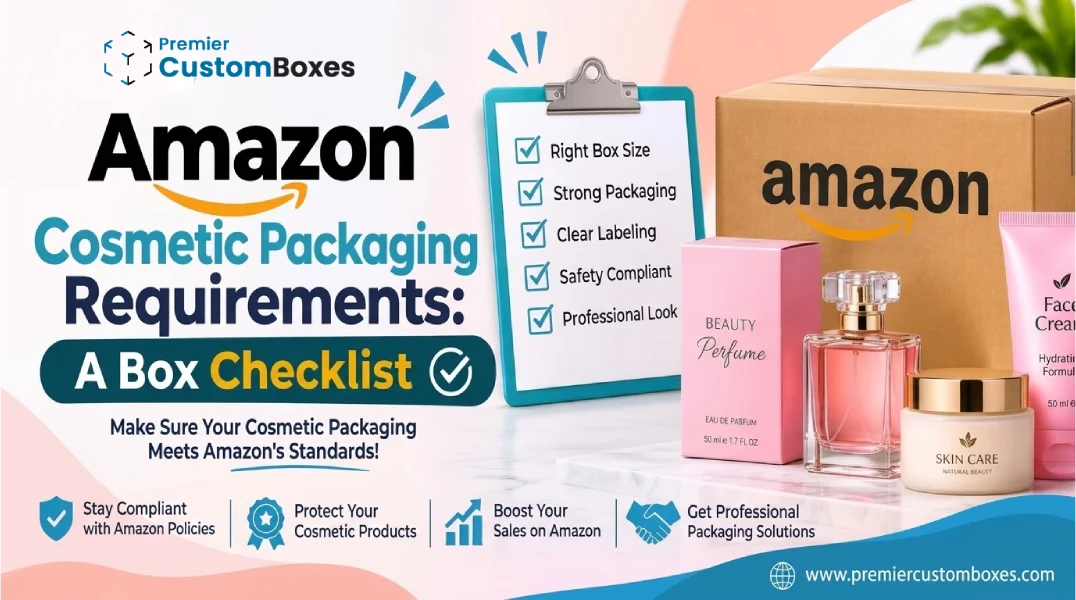
Run through this table before you approve your proof. It's the fastest way to catch gaps in Amazon-ready cosmetic boxes.
| Area | Check |
|---|---|
| Box | Six-sided and fully closed; sealed; fits product snugly; insert for glass or liquids |
| Front panel | Product name, what it is, net quantity |
| Information panel | Ingredient list, company name and place, warnings, MoCRA contact |
| Barcode | One scannable barcode; matte area; quiet zone; not on a fold |
| Codes | Lot or batch number in a fixed, clear spot |
| Dates | Expiration in MM-DD-YYYY or MM-YYYY at Amazon's size, on unit and outer packaging |
| Claims | No FDA approval wording, no medical claims, no "tester" |
| Openings | Passes drop test, or bagged with suffocation warning |
| Shipping carton | Old barcodes covered; FBA Box ID label applied |
Rules differ by state and product type; check Seller Central and your local regulations before you ship.
How can Premier Custom Boxes help with Amazon FBA cosmetic packaging?
We build the box; you bring the label text and barcode plan. We can't promise Amazon acceptance or legal compliance for your product. What we can do is give you a box with room for every required item, laid out so it reads and scans well.
- Free design support with unlimited revisions, free CAD templates (dielines) and free proofing before printing.
- Any size, shape and material, including cardboard, kraft, corrugated and rigid stock. Recyclable kraft cardstock is available if you want an eco-friendly box.
- Finishes and add-ons: spot UV, gloss and matte coating, foil stamping, embossing, die-cut windows, custom inserts and QR codes. We'll help you keep shiny finishes away from the barcode area.
- Offset and digital printing with four-color CMYK inks for sharp color and clean edges.
- Low minimums from 100 boxes, so you can test a new product without overbuying.
- Free shipping across the USA, to all 50 states.
- 10–12 business day standard turnaround, with rush service that ships within a week.
Not sure which style, material or finish fits your product? Our packaging team can help you choose. Tell us what you're packing and how many boxes you need. We'll send a free mockup and a clear quote. Call us at (800) 844-1443 in the USA or (02) 7257-6566 in Australia, or email justin@premiercustomboxes.com.
Frequently asked questions
Does Amazon require cosmetics to be sealed?
Yes. Amazon's cosmetics policy says products must be new, unused and sealed in the original manufacturer packaging. They also need an identifying code, such as a lot number, serial number or matrix code.
Do I need to print the ingredient list on my cosmetic box?
If your product ships in a folding carton, yes. FDA only allows an off-package ingredient list in narrow cases, and folding cartons don't qualify. Print the full list on a side or back panel.
Can my box show both a UPC and an FNSKU?
Both can be on the box, but only one should scan. Print the UPC in a matte block sized so the FNSKU sticker covers it completely.
What format does Amazon want for expiration dates?
Amazon's prep post lists MM-DD-YYYY or MM-YYYY, in 36-point font or larger. The date must appear on both the outer packaging and each unit.
Do cosmetic boxes with windows need a poly bag?
Boxes with perforations or openings must pass a 3-foot drop test or go in a poly bag. Bags with openings of 5 inches or larger need a suffocation warning. Check Seller Central for the latest rules before you add a window.
What is the minimum order for custom cosmetic boxes?
Our minimum is 100 boxes. Standard production takes 10–12 business days, rush orders ship within a week, and shipping is free across the USA.
Will your team check my label against Amazon and FDA rules?
We lay out your box with space for every required label item and a clean barcode area. We don't give legal advice, so check your label text with a regulatory advisor. Rules differ by state and product type; check your local regulations.
Ready to plan your Amazon-ready cosmetic box? Get a Free Quote today, and we'll send your free mockup with it.