Last updated: November 2026
Many brands ask "how much do custom cosmetic boxes cost?" and then trust the first per-box price they find online. That's a mistake. The price was set for someone else's box, which may have a different size, board, quantity or finish. Two prices can look miles apart simply because they describe two very different boxes.
A better approach is to decide your specs first: size, style, material, printing, finishes and quantity. Then ask for a price on that exact box. Below, we walk through what each choice does to the price and why, so you know where to spend and where to save.
Quick answer: how much do custom cosmetic boxes cost?
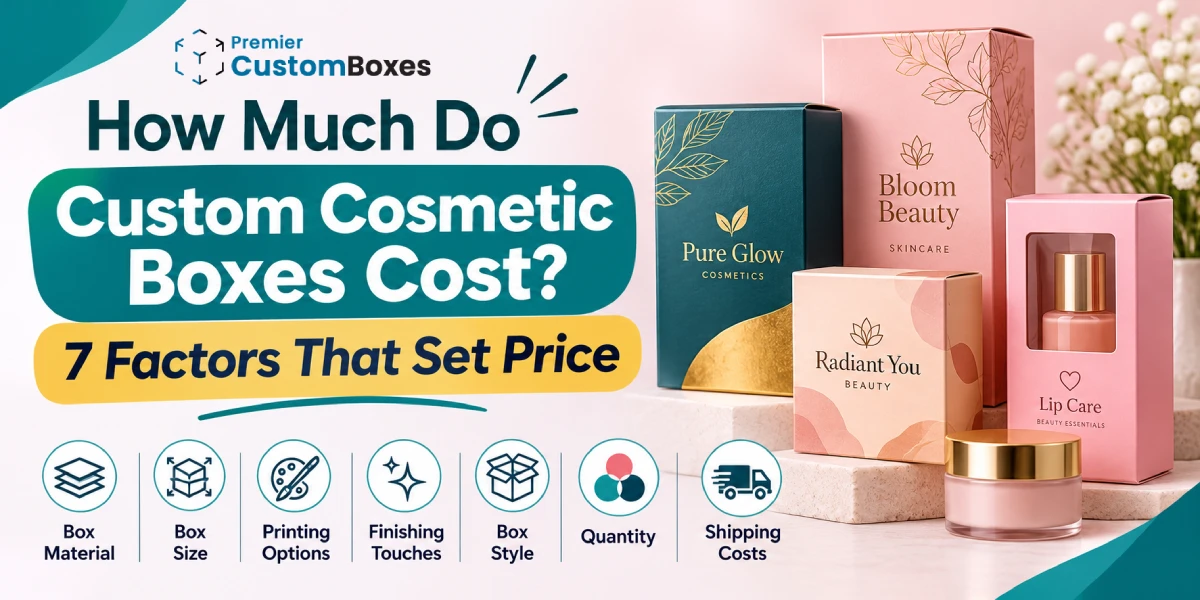
Short answer: There's no single price for custom cosmetic boxes. The cost of each box depends on seven things: order quantity, size and shape, material, box style, printing, finishes, and extras like inserts or windows. Cardstock tuck-end boxes in larger runs cost the least. Small runs of rigid boxes with foil cost the most.
Because the price follows your specs, the honest answer is a set of cost levels, not one dollar figure. Price lists you find online rarely match each other, and none of them describe your box. That's why we don't publish a flat price. We quote the box you actually need.
Key takeaways
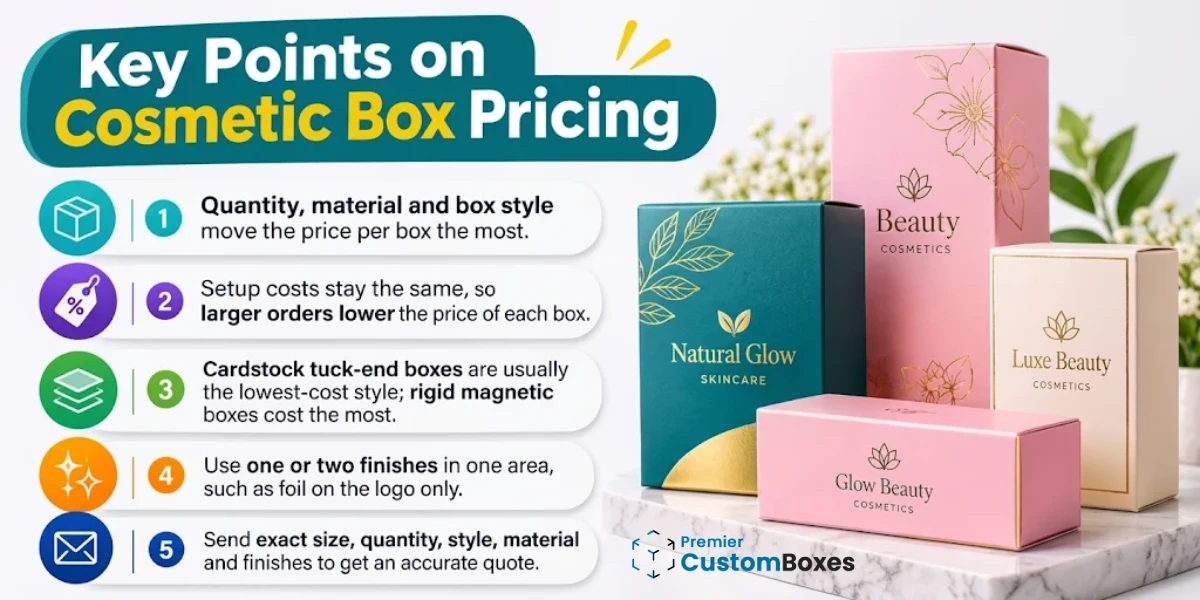
- Quantity, material and box style move the price the most. Finishes come next, then extras.
- Setup costs are the same for 100 or 1,000 boxes, so bigger orders cost less per box.
- A cardstock tuck-end box is usually the best value for most beauty products.
- Rigid and magnetic boxes look premium but cost the most. Save them for a hero product or gift set.
- Plan room for FDA label information early, so you don't pay for a redesign or reprint.
Why one price doesn't exist
Every box price is built from the same parts. Here's a simple formula for cosmetic packaging cost per unit (the price of one box):
(materials + printing + finishes + labor + setup + shipping) ÷ number of boxes = cost per box
Change any part, and the result changes. Some parts grow with every box, like board and ink. Others are one-time costs, like the cutting die. That second group is the reason quantity matters so much. (On shipping, we ship free to all 50 US states, so that part of the formula is covered for US orders.)
As general guidance, the cost drivers rank like this:
- Biggest effect: quantity, material and box structure.
- Medium effect: finishes such as foil, embossing and soft-touch.
- Smaller effect: extras such as inserts, windows and inside printing. Foam inserts and complex windows can add more.
Cardstock vs kraft vs corrugated vs rigid: side-by-side comparison
For most cosmetic brands, a printed cardstock tuck-end box gives the best value. Kraft costs about the same and has a natural look. Corrugated is built for shipping, and rigid boxes are for premium moments.
| Option | What it is | Look and feel | Cost level | Best for |
|---|---|---|---|---|
| Cardstock folding carton (tuck-end) | Smooth white paperboard that ships flat and closes with tucked flaps | Clean, sharp color printing | Lower | Lipstick, mascara, cream jars, serums |
| Kraft folding carton | Brown, natural paperboard | Earthy, eco look | Lower | Natural and clean-beauty brands |
| Corrugated mailer | Board with a wavy middle layer between two flat layers | Sturdy, practical | Medium | Online orders, subscription boxes, kits |
| Rigid box | Thick, firm board that doesn't fold flat | Heavy, premium, reusable | Higher | Perfume, gift sets, PR kits |
| Magnetic-closure rigid box | Rigid box with a hidden magnet that keeps the lid shut | Luxury, satisfying to open | Highest | Hero products and high-end sets |
Key Points on Cosmetic Box Pricing
Factor 1: How does order quantity change the price per box?
The more boxes you order, the less each one costs. That's mostly because setup costs get shared across more boxes.
Setup costs spread over more boxes
Before printing starts, the press has to be set up. Offset printing needs plates, and most boxes need a die, the metal tool that cuts the box shape. These are one-time costs. It's a bit like heating an oven: it takes the same energy whether you bake one tray of cookies or ten.
Why 100 boxes cost more each than 1,000
With 100 boxes, each box carries one hundredth of the setup cost. With 1,000 boxes, each carries one thousandth, a share ten times smaller. Board, ink and labor also get cheaper per box when the press runs longer without stopping.
That's why a wholesale cosmetic boxes price you see online often assumes a large run. It won't match a small first order.
Order to a price break
A price break is the quantity where the cost per box drops to a lower tier. Ask for prices at two or three quantities, and you'll see where it falls. Our honest view: don't overbuy just to hit a break. If your formula, label or branding may change soon, extra boxes can turn into waste.
Starting small makes sense for a new product, and our minimum is just 100 boxes. Our startup guide to low-minimum cosmetic boxes explains how to plan that first run.
Factor 2: How do box size and shape affect cost?
Bigger boxes use more board and take more room in shipping, so they cost more. Unusual shapes cost more because they waste material and may need a new cutting die.
Measure the product in inches
Measure length, width and height (L × W × H) in inches. Measure the container as it will ship, with the cap, pump or dropper on. A box that's too big needs filler, uses extra board and costs more to ship. A box that's too small means a reprint.
For example, a serum bottle measured without its dropper can end up in a box that won't close. Our step-by-step guide on how to measure your product for a custom cosmetic box shows where people usually go wrong.
Die-cut shapes and waste
Boxes are cut from large flat sheets. Simple rectangles fit close together, like tiles on a floor. Curved or odd shapes leave gaps between pieces, and you still pay for that unused board. A custom shape can be worth it for a signature product. Just know it adds cost.
Standard vs custom size
We make any size and shape on request, so you're never forced into a box that doesn't fit. Still, a plain rectangle sized close to your product is usually the cheaper choice.
Factor 3: Which material costs the least and which costs the most?
Cardstock and kraft paperboard usually cost the least. Corrugated sits in the middle. Rigid board costs the most because it's thick and needs more hand work.
Thickness matters too. Board thickness is measured in points (pt), and weight in GSM (grams per square meter). Thicker board feels sturdier and costs more. Pick the thickness your product needs, not the thickest one on the list. A lip balm doesn't need the same board as a glass perfume bottle.
Cardstock (SBS or C1S paperboard)
This is smooth white paperboard. C1S means it's coated on one side, which gives ink a clean surface to sit on.
- Pros: sharp, bright color printing; ships flat; low cost.
- Cons: less crush protection inside a shipping carton.
Kraft
Kraft is brown, natural-looking board. We offer recyclable, biodegradable kraft cardstock made with sustainable raw materials.
- Pros: eco look; low cost; suits natural brands.
- Cons: colors print darker on a brown base, so bright brand colors can look muted. It's like painting on brown paper instead of white.
Corrugated
- Pros: strong; protects glass bottles in the mail; good for mailer and subscription boxes.
- Cons: bulkier; fine details print less crisply than on smooth cardstock.
Rigid board
- Pros: premium weight and feel; customers often keep and reuse the box.
- Cons: highest cost; doesn't fold flat, so it takes more room to ship and store.
Factor 4: Does the box style change the price?
Yes. Simple one-piece styles cost less. Styles with more parts or hand assembly cost more.
Tuck-end, sleeve, window, drawer and magnetic-lid
- Tuck-end: one flat piece with tucked flaps. Usually the lowest-cost style.
- Sleeve: a printed band that slides over a tray or box. It adds a second piece.
- Window box: adds a cut-out and a clear film, which means extra steps.
- Drawer box: a tray that slides out of an outer case, often built in rigid board.
- Magnetic-lid box: a rigid box with hidden magnets. It needs the most assembly.
When rigid is worth it
Rigid boxes make sense for a hero product, a holiday gift set or an influencer kit. For the rest of a line, they usually aren't needed. A smart mix is rigid for one launch product and cardstock or kraft tuck-end boxes for everyday items. Shoppers still get a premium moment, and you don't pay rigid prices for every SKU (each separate product you sell).
Factor 5: How do printing choices affect cost?
Standard full-color printing costs less than special inks. The right print method depends on how many boxes you need.
CMYK vs Pantone
CMYK uses four inks (cyan, magenta, yellow and black) that mix to make full-color images. A Pantone, or PMS, color is a special premixed ink for one exact brand shade. Pantone usually costs more because the press needs an extra ink. If CMYK gets close enough to your color, use it.
Offset vs digital printing
Digital printing prints straight from your file with no plates, so it suits small runs. Offset printing uses plates on a large press and keeps color steady across bigger runs. We offer both, including four-color offset with CMYK inks, and our team can tell you which one fits your quantity.
Printing inside the box
Printing inside means a second print pass. It can make a lovely unboxing experience, but it adds cost. Heavy ink coverage, like a full black box, also uses more ink than a design with white space.
Factor 6: How much do finishes add?
Each finish adds some cost. Finishes that need their own tool, like foil and embossing, add the most. Coatings are the lightest add-on.
| Finish | What it looks like | Effect on cost | Best for |
|---|---|---|---|
| Matte or gloss coating | Flat or shiny protective layer | Lower | Every box; protects print |
| Soft-touch coating | Velvety matte feel, like suede | Medium | Skincare and premium makeup |
| Spot UV | Shiny clear coat on chosen spots, such as a logo | Medium | Making a logo stand out on matte |
| Foil stamping (gold or silver) | Metallic film pressed on with heat | Medium to higher | Logos, perfume, gift boxes |
| Embossing or debossing | Design raised up or pressed down into the board | Medium to higher | Logos you want customers to feel |
Pick one or two, not all
Finishes work like pizza toppings: each one adds to the bill, and too many crowd the plate. Stacking foil, embossing, spot UV and soft-touch on one box adds a production step each time, and it can look busy. We usually suggest one hero finish in one spot, such as gold foil on the logo only.
If you're torn between coatings, our post on matte vs gloss cosmetic boxes compares them. Free coatings are part of our standard offer, so ask our team which options are included for your box.
Factor 7: What about inserts, windows and other extras?
Inserts and windows add material and steps, so they raise the price. The right insert can also cut breakage, which saves money later.
Insert types and protection
An insert is a shaped piece inside the box that holds the product still. Common types are paperboard, molded pulp and foam. Paperboard is usually the simplest choice. Foam is often picked for fragile glass, like perfume bottles. Our guide to choosing the right cosmetic box insert covers each type.
Windows and QR codes
A die-cut window with clear PVC film lets shoppers see the product. It adds a cutting step and the film itself. A QR code is different. It's just part of your artwork, so it costs about the same as printing any other small graphic.
Space for required FDA labels
Planning label space early is one of the easiest ways to avoid paying twice. Under the FDA summary of cosmetics labeling requirements, the outer container, which is usually the box, carries key label information. The principal display panel (PDP), the front shoppers see first, must show the product name, what the product is or does, and an accurate net quantity of contents. Ingredient rules also apply to the box, so you'll need room for that list too.
A few layout details from 21 CFR Part 701 (Cosmetic Labeling) affect your design:
- On panels larger than 5 square inches, net quantity sits in the bottom 30% of the PDP.
- On panels of 5 square inches or less, that placement rule doesn't apply, and the minimum type height is 1/16 inch. Small lipstick and lip balm boxes get a bit more freedom.
- If a box has more than one principal display panel, the required front information must repeat on each one. That means more artwork work.
The FDA Cosmetics Labeling Guide walks through the front and side panels step by step. Rules differ by state and product type; check your local regulations and the current FDA rules before you approve artwork. We design boxes with space for required labels, but your team decides what goes in that space.
Which box should you choose for your budget?
Match the box to the job. A test launch needs a simple, low-cost box, while a gift set can carry a premium build.
| Your situation | Best style, material and finish | Cost level | What raises or lowers cost |
|---|---|---|---|
| Startup test run of one product | Cardstock or kraft tuck-end, CMYK, one coating | Lower | Raises: custom shapes, many finishes. Lowers: simple rectangle |
| Mid-range retail line | Cardstock tuck-end, one shared size, spot UV or foil logo | Medium | Lowers: same board and dieline across products |
| Online orders shipped to homes | Corrugated mailer with paperboard insert | Medium | Raises: full inside printing. Lowers: right-sized box |
| Eco-focused brand | Kraft with light ink coverage | Lower | Raises: heavy full-color coverage |
| Luxury gift set | Rigid magnetic box, foil logo, fitted insert | Higher | Lowers: foil in one spot, paperboard insert where safe |
How can you lower custom cosmetic box cost?
The fastest savings come from right-sizing the box, using fewer finishes and keeping one standard size across your line. None of these leave you with a cheap-looking box.
Practical ways to save
- Right-size the box. A snug box uses less board, needs less filler and ships in less space.
- Simplify finishes. One strong finish in one spot often looks more polished than four.
- Use kraft or cardstock where it fits. Keep rigid for the product that earns it.
- Standardize sizes. If a cream and a serum can share one box size, they can share one dieline (the flat map of cut and fold lines).
- Check the free proof carefully. A proof is a preview of the finished box. Catching a typo there costs nothing; catching it after printing means a reprint.
Common mistakes that raise the price
- Ordering a box much bigger than the product.
- Using Pantone colors where CMYK would match well enough.
- Printing inside the box when nobody will notice it.
- Making artwork changes after the proof is approved.
- Splitting a small order into many designs instead of a few.
- Forgetting label space, so the box needs a redesign.
What should you send to get an accurate quote?
Send the same core details every supplier needs: style, size, quantity, material, printing and finishes. The clearer your request, the closer the quote will be to your final bill.
Quote checklist
- Box style (tuck-end, sleeve, mailer, rigid, magnetic)
- Product size in inches (L × W × H)
- Quantity, plus one or two higher quantities to compare
- Material and thickness, if you know them
- Print sides (outside only, or inside too)
- Finishes (coating, foil, embossing, spot UV)
- Extras such as inserts, windows or a QR code
- Your artwork, or a note that you'd like help with design
Not sure about some of these? That's fine. Send what you know, and our packaging team will help you choose the style, material and finish that fit your product and budget.
Frequently asked questions
What is the minimum order for custom cosmetic boxes?
Our minimum order is 100 boxes. That makes it easier to test a new product without tying up cash in packaging you may need to change later.
How long does it take to get custom cosmetic boxes?
Standard turnaround is 10–12 business days. If you're up against a launch date, our rush service ships within a week.
Is shipping included in the price?
Yes, for US orders. We ship free to all 50 states. We also serve Australia, so contact our team about delivery for Australian orders.
Which material is cheapest for cosmetic boxes?
Cardstock and kraft paperboard usually cost the least. Corrugated sits in the middle, and rigid board costs the most. A cardstock tuck-end box is the best value for most beauty products.
Do finishes like foil and embossing add a lot to the cost?
They add more than a basic coating because each needs its own tool and step. Using one finish in one spot, such as foil on the logo, keeps the cost down and often looks cleaner.
Do you help with box design?
Yes. Design support is free, with unlimited revisions. You also get a free proof before printing, free coatings and CAD templates (digital layout files of your box shape).
Does my cosmetic box need FDA label information?
Usually, yes. FDA rules put key label details, like the product name and net quantity, on the outer container, which is often the box. Rules differ by state and product type; check your local regulations. We'll leave space for required labels in your design.
Ready to price your cosmetic boxes?
Tell us what you're packing and how many boxes you need. Our team will send a free mockup and a clear quote, and we'll stay with you until the boxes reach your door. You get free design support, free shipping across the USA and a low 100-box minimum, plus full control over size, style, material and finish.
Call us at (800) 844-1443 (USA) or (02) 7257-6566 (Australia), or email justin@premiercustomboxes.com. Get a Free Quote today and see exactly what your custom printed cosmetic boxes will cost.