Last updated: November 2026
Many new beauty founders assume the factory that makes their formula also carries the legal duties for it. Under U.S. law, that's often not the case. FDA treats the company whose name appears on the label as the "responsible person" for that cosmetic. If you sell a private label serum under your brand, many of those duties land on you.
That's why private label cosmetic packaging needs more thought than "pick a bottle, add a logo." Your container and box carry your brand, your label text and your first impression. When you plan them well, a stock product looks like your own. When you rush, you may end up paying for a second print run.
Quick answer: Private label cosmetic packaging is ready-made containers, such as jars, tubes, bottles and compacts, branded with your name and logo, plus the outer box you design. Most new brands keep a stock container and invest in a custom printed box. The box holds most of the branding and much of the required U.S. label information.
Key Takeaways
- Private label usually means a stock container plus your own custom printed outer box.
- If your brand name is on the label, FDA treats you as the responsible person under MoCRA.
- The ingredient list and net quantity can go on the outer carton, not only on the bottle.
- Measure the final container before you order boxes, and build artwork on the dieline.
- One or two well-chosen finishes often look better than stacking every option.
What Is Private Label Cosmetic Packaging?
Private label cosmetic packaging is the packaging for a product another company makes and you sell under your brand name. The container is often a standard format that the supplier already keeps in stock. Your logo, your colors and your printed box are what make it yours.
Private label vs white label vs custom (OEM)
People mix these terms up all the time, so here are the plain definitions. Private label means another company makes the product and you sell it under your brand, often with some say in the formula and packaging. White label is a ready-made product sold to many brands with only a new label, so you get fewer choices.
OEM means a factory makes a product to your own design. ODM means it makes one from its own design for you to brand. Both usually need bigger orders than private label.
| Model | Control over look | Order size | Speed to market |
|---|---|---|---|
| White label cosmetics and packaging | Low: new label only | Usually small | Fast |
| Private label with stock containers + custom printed boxes | Medium to high: your box carries the brand | Small to medium | Fast to moderate |
| Full custom / OEM packaging | Highest: unique container shapes and molds | Usually large | Slowest |
Our honest view: the middle row is the best fit for most startups. You skip the cost of custom molds, and your packaging still doesn't look like everyone else's.
Primary vs secondary packaging
Primary packaging is the container that touches the product. That could be a jar, a tube, a private label cosmetic bottle, a compact, a dropper or an airless pump. Secondary packaging is the outer box or carton around it, plus any inserts and labels.
The secondary layer is where most of your branding and label text goes, and it's the part we make at Premier Custom Boxes. Your formula and filling stay with your manufacturer.
What New Private Label Brands Should Know
Myths vs Facts: What New Brands Get Wrong About Private Label Packaging
Most costly packaging mistakes start with a handful of common beliefs. Below are the ones we hear most often, along with what FDA's rules and everyday practice actually say.
Myth: Private label means plain, generic packaging
The truth: The container may be stock, but the box doesn't have to be. For example, the same dropper bottle looks very different inside a soft-touch carton with a gold foil logo than inside a plain white box. Custom packaging for private label brands lets you choose the size, style, material and finish of the outer box, so your shelf look belongs to you alone.
Myth: The manufacturer handles all the legal side for me
The truth: According to FDA's MoCRA overview, the responsible person is the manufacturer, packer or distributor whose name appears on the label. For a private label product, that's usually your brand.
FDA says the responsible person must list each marketed product with FDA, including its ingredients, and update that listing every year. They must also keep records that support the product's safety and report serious adverse events to FDA within 15 business days. Before launch, agree in writing with your manufacturer on who handles each task, and check the details on FDA's site.
Myth: My packaging needs FDA approval
The truth: What matters is whether your label follows FDA's rules. FDA says a cosmetic is "misbranded" if its labeling is false or misleading, or if it leaves out required information. So be careful with any supplier that sells "FDA approved" cosmetic boxes. A box can give you room for the right information, but the words you print on it are what FDA looks at.
Myth: All the required label text must fit on the tiny bottle
The truth: The FDA summary of cosmetics labeling requirements explains that rules under the Fair Packaging and Labeling Act (FPLA) apply to the label of the outer container. That includes the ingredient list and the net quantity on the front panel. FDA also says the ingredient list may go on any information panel, including the folding carton.
This is good news for small items. A lip balm tube or a small eye cream jar has very little label space, but a custom box gives you several full panels to work with.
Myth: I can order boxes before the container is final
The truth: This mistake can cost you a full reprint. If your supplier switches the cap style or the bottle shape, your box may not close, or the product may rattle inside. Wait until you have the final container in hand, then measure it.
Myth: A premium look means paying for every finish
The truth: Stacking foil, embossing, spot UV and a window on one small box can look busy and push up your cost. One strong feature, such as foil on the logo, usually looks cleaner. Spend your budget where the customer's eye lands first.
Myth: Small brands can't get custom boxes because minimums are huge
The truth: MOQ (minimum order quantity) is the smallest number of items a supplier will make in one order. MOQs vary a lot by supplier and box style. At Premier Custom Boxes, custom boxes start from 100 units, which works well for brands testing a first product.
Myth: Any container works with any formula
The truth: Some formulas react badly to air or light. An airless pump pushes product out without letting air back in, which helps protect many creams and serums. Ask your formula maker which container type they recommend before you design anything.
| Myth | Fact |
|---|---|
| Private label means generic packaging | Stock containers can sit inside fully custom printed boxes |
| The manufacturer handles the legal side | The name on the label is the responsible person under MoCRA |
| Packaging needs FDA approval | Your label must be truthful and complete; be wary of "FDA approved" box claims |
| All label text must fit on the bottle | Ingredients and net quantity can go on the outer carton |
| Order boxes first, containers later | Measure the final container before ordering boxes |
| Premium means every finish | One or two focused finishes often look better |
| Minimums are too high for startups | MOQs vary; ours start from 100 boxes |
| Any container suits any formula | Airless or opaque containers protect sensitive formulas |
How Do You Choose Packaging for a Private Label Brand?
Start with the formula, then the container, then the box. Working in that order keeps you from paying twice.
- Match the container to the formula. Jars suit thick creams, and tubes suit cleansers and lip gloss. Droppers work for oils and serums, while airless pumps protect air-sensitive formulas.
- Measure the container for a custom box. Measure length, width and height in inches, including the cap or pump. Leave room for an insert if you plan to use one. Our guide on how to measure your product for a custom cosmetic box walks you through each step.
- Pick the box style and material. A tuck end box is a carton with flaps that tuck in at the top and bottom. It's a common, budget-friendly choice. Sleeves and rigid boxes feel more premium in the hand.
- Choose finishes that fit your budget. The finish table below compares the main options.
- Set up artwork on the dieline. A dieline is a flat outline of the box that shows where it folds and where it gets cut. Artwork placed off the dieline can land on a fold or get trimmed away.
- Approve a proof, then order the full run. Check every word, panel and color before printing. We send a free proof first, so you can catch problems while they're still free to fix.
Which Box Material and Finish Is Best for Startups?
For most new brands, a printed cardstock folding carton is the safest place to start. It's affordable, prints well and fits most bottles and jars. Rigid boxes make more sense for gift sets and high-end products.
| Material | Best for | Look and feel | Relative cost |
|---|---|---|---|
| Kraft (brown, recyclable stock) | Natural or eco-focused skincare, soaps, lip balm | Earthy, simple | Low |
| Cardstock folding carton | Serums, creams, lipstick, mascara, foundation | Clean, sharp full-color print | Low to medium |
| Corrugated (fluted board) | Shipping, subscription boxes, multi-item orders | Sturdy, protective | Medium |
| Rigid (thick board, does not fold flat) | Gift sets, perfume, luxury creams | Heavy, premium | Higher |
Most full-color boxes print in CMYK. That's the four ink colors (cyan, magenta, yellow and black) that combine to build almost any color. We offer offset printing, which uses printing plates and suits larger runs. We also offer digital printing, which prints straight from a file and suits smaller runs.
| Finish | What it does | Relative cost |
|---|---|---|
| Matte coating | Smooth, soft, low-shine look | Low |
| Gloss coating | Bright, shiny colors | Low |
| Soft-touch | Velvety feel in the hand | Medium |
| Spot UV | Glossy shine on chosen spots, like a logo | Medium |
| Foil stamping | Shiny gold or silver metallic detail | Medium to higher |
| Embossing | Raises a shape so you can feel it | Medium to higher |
Can't decide between the first two? Our post on matte vs gloss cosmetic boxes compares them side by side.
Private Label Makeup and Skincare Packaging Ideas
Good private label packaging ideas start with how the product gets used and sold. A lipstick on a store shelf needs different packaging than a cream shipped to a customer's door.
Private label makeup packaging
- Lipstick: a stock tube in a slim sleeve or tuck end box, with foil on the logo.
- Mascara and foundation: tall folding cartons with room for shade names. Browse our custom cosmetic boxes to compare styles.
- Lip balm and eyelash kits: small boxes with a die-cut window, so shoppers can see the product before they buy.
- Gift sets: a rigid or magnetic-lid box with custom inserts that hold each item in place. Private label cosmetic bags also work well as a reusable add-on.
Private label skincare packaging
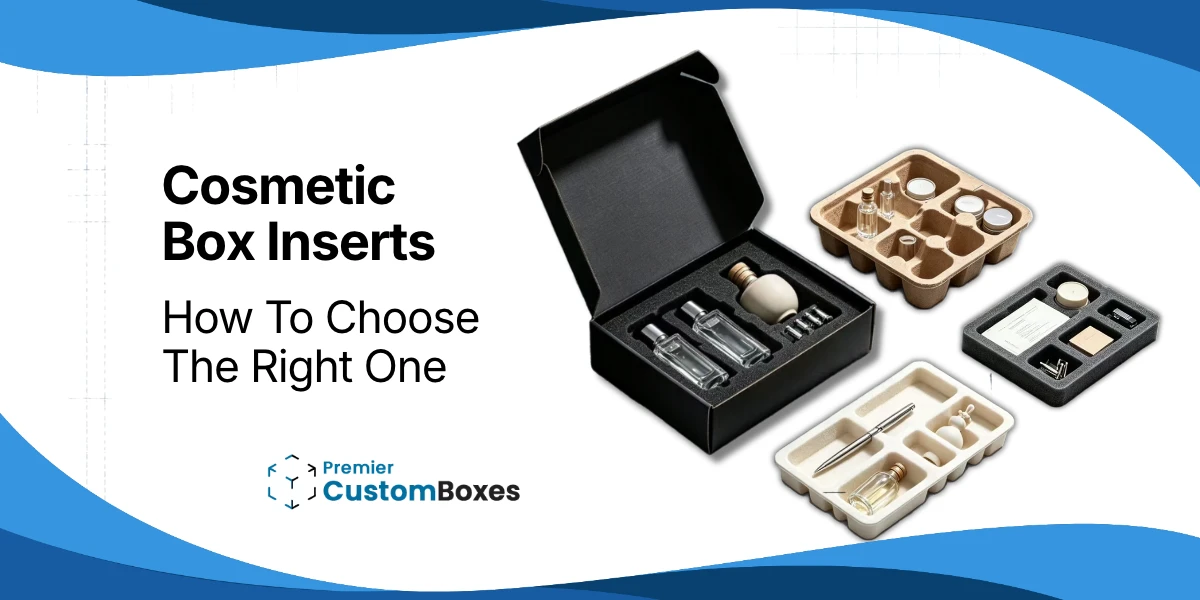
Serums, creams and eye creams often need extra protection. An insert stops a glass jar from sliding around in transit, and an opaque box helps block light. Our custom cream boxes can be built around your exact jar size. For help picking a holder, read how to choose the right cosmetic box insert.
What Must Go on a Cosmetic Box in the U.S.?
A U.S. cosmetic box needs certain details on the front and on a side or back panel. Here's a simple panel map based on FDA's rules, which are set out in 21 CFR Parts 701 and 740.
Front panel (PDP)
The principal display panel (PDP) is the front of the box that shoppers see first. FDA says it must show the product name and the nature or use of the product, such as "face cream." It must also show an accurate net quantity of contents, meaning how much is inside by weight, measure or count.
If a box has more than one front-style panel, 21 CFR Part 701 on cosmetic labeling says this information must be repeated on each one. Small boxes get their own rule. When the front panel is 5 square inches or less, the net quantity type must be at least 1/16 inch high.
Information panel
The information panel is the side or back of the box. It can hold the ingredient list, and it must show the name and place of business of the company marketing the product. For example, a small serum box might carry the product name and net quantity on the front, with ingredients and your business details on the back.
MoCRA: responsible person and contact details
MoCRA (the Modernization of Cosmetics Regulation Act of 2022) is, in FDA's words, the biggest expansion of its cosmetics authority since the 1938 FD&C Act. Industry guides say it also asks brands to print U.S. contact details on the label, so customers can report problems. Check FDA's current guidance for the exact wording. Make sure the company name on your box matches your responsible person. Rules for fragrance allergen labeling are still being finalized, so keep an eye out for FDA updates.
Rules differ by state and product type; check your local regulations. We design your box with space for required labels, but we can't give legal advice or confirm that your product complies.
How Do MOQs and Costs Work for Startups?
Box prices depend on size, material, finish, quantity and printing method. Bigger runs usually lower the cost per box. Special finishes and rigid board raise it.
Watch for an MOQ mismatch. Your container supplier and your box supplier may have different minimums, and that gap can leave you with extra bottles or extra boxes. Plan both orders together so the numbers line up.
At Premier Custom Boxes, you can start from 100 boxes, and gloss or matte coatings are free. For more detail, read our low minimum custom cosmetic boxes guide. We don't publish fixed prices because every box is built to order. A free quote is the fastest way to get real numbers for your project.
What to Do Instead: A Safe-Start Checklist
Run through this list before you place your first packaging order. Each step heads off one of the myths above.
- Confirm the final container, cap and pump with your manufacturer.
- Measure the filled container in inches, including the closure.
- Agree on who the responsible person is and whose name goes on the label.
- Map your front panel and information panel text before design starts.
- Build artwork on the supplier's dieline or CAD template.
- Choose one or two finishes that match your budget.
- Line up container and box quantities to avoid leftover stock.
- Check every proof line by line before you approve it.
How Premier Custom Boxes Can Help
We make custom printed boxes for beauty brands of every size, from a first test run to a full product line. For private label brands, we offer free design support with unlimited revisions, free CAD templates and a free proof before printing. Shipping is free to all 50 states.
Standard turnaround is 10–12 business days, and rush service ships within a week. We can make any size, shape or material on request. Not sure which style fits your product? Our packaging team will help you choose the box, the material and the finish.
Frequently Asked Questions
What is private label cosmetic packaging?
It's the containers and boxes that carry your brand on a product made by another company. Most brands pair stock containers with a custom printed outer box.
What is the difference between private label and white label cosmetics?
White label gives you fewer choices. It's a ready-made product sold to many brands with a new label. Private label usually lets you choose more of the formula and packaging.
What is the minimum order for private label cosmetic packaging?
It depends on the supplier and the box style. At Premier Custom Boxes, custom printed boxes start from 100 units.
Can I put my logo on private label products?
Yes. Putting your logo on the product is the whole point of private label. It can go on the container, the label and the outer box. Just remember that the name on the label becomes the responsible person under MoCRA.
What must be on a cosmetic box label in the U.S.?
The front needs the product name, what the product is and the net quantity. A side or back panel needs the business name and place of business, and it can carry the ingredient list. Check FDA rules and your state rules for your product.
Can I use stock containers with custom boxes?
Yes, and it's one of the smartest ways for a new brand to start. Send us your container measurements, and we'll size the box and any insert to fit.
Do you provide free design help and a dieline?
Yes. We offer free design support with unlimited revisions, free CAD templates and a free proof before printing.
Start With the Right Box
A stock container and a well-made custom box can give your private label line a look that feels fully yours. Measure first, plan your label panels, and keep your finishes focused. Those three habits prevent most of the costly mistakes new brands make.
When you're ready, get a free quote from Premier Custom Boxes. Tell us your box size, quantity and style, and our packaging team will send you pricing and a free design mockup. Request your free quote today, or call us at (800) 844-1443.