Last updated: November 2026
A customer opens her first order from your brand. Face cream is smeared across the inside of the box. The lid worked loose somewhere between your warehouse and her porch, so she's writing to ask for a refund instead of posting her unboxing.
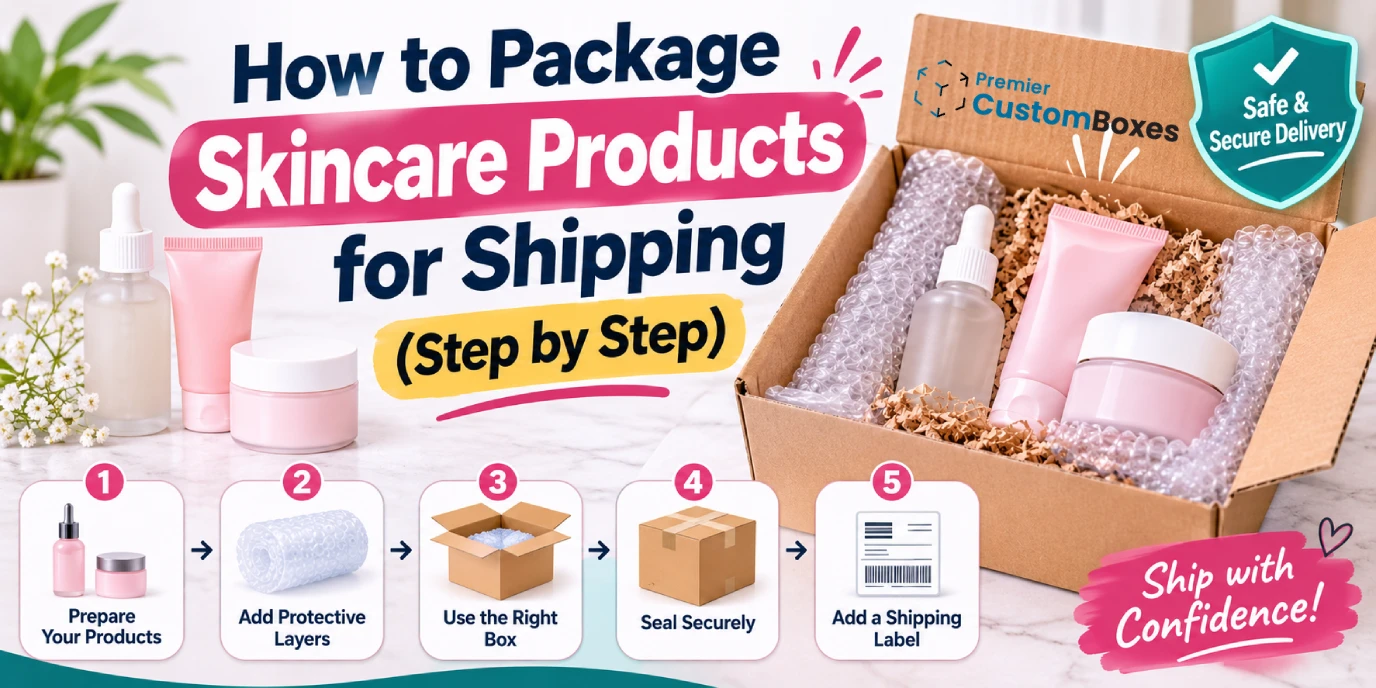
You can prevent that with a few habits you repeat on every order. Here's how to package skincare products for shipping: seal every closure, bag each jar or bottle with something absorbent, and wrap each item. Then hold everything still with an insert inside a snug, strong box. Each step below is short. Together, they stop most leaks and breaks before they start.
Quick answer: what does safe skincare shipping take?
To package skincare products for shipping, tighten and seal every lid. Put each jar or bottle in a sealed plastic bag with an absorbent pad, wrap it, and hold it in place with an insert. Then use a right-size corrugated box, add about 2 inches of cushioning on every side, and tape it shut in an H pattern.
| What you need | Time | Result |
|---|---|---|
| Sealed closures, zip bags, absorbent pads, wrap, inserts, a corrugated box, void fill, wide packing tape | A one-time setup to plan your pack-out, then a few minutes per order | Orders that arrive without leaks or broken glass, in a box that looks good when it's opened |
Why do skincare products leak and break in transit?
Skincare fails in the mail for five main reasons: loose caps, air pressure changes, heat, drops and items knocking into each other. Once you see how each one works, the fixes make sense.
Start with pressure. Every filled jar or bottle has a small air gap at the top, called headspace. When a parcel flies or crosses mountains, the air pressure outside drops. The air inside the container pushes outward and can force cream or serum past a lid that isn't tight. Heat makes it worse, because warm air expands and warm formulas get thinner.
Breakage is simpler. Parcels get dropped, stacked and shaken on conveyor belts. A glass jar that can slide even a little will hit the box wall or another jar. Wide-mouth cream jars carry extra risk, since a wide lid has a long seal line where product can escape.
You'll see a few terms again below:
- Primary packaging is the container that touches the product, such as the jar, bottle or tube.
- Secondary packaging is the box or bag around that container.
- Shipping box (shipper) is the strong outer box that goes through the mail. It's usually made of corrugated board.
- Corrugated board is cardboard with a wavy layer inside. It's light but strong.
Key Takeaways for Shipping Skincare
What do you need before you start packing?
You need the right supplies, your product's exact measurements and a quick check of carrier rules. A little prep now saves you from reshipping orders later.
Materials checklist
- Shrink bands, inner seals or tape for every lid
- Zip-top or heat-sealed plastic bags
- Absorbent pads (small pads that soak up spills)
- Bubble wrap or paper wrap
- Inserts or dividers sized to your products
- Corrugated shipping boxes or mailer boxes
- Void fill, such as kraft paper or air pillows
- Strong, wide packing tape
Measure your product in inches
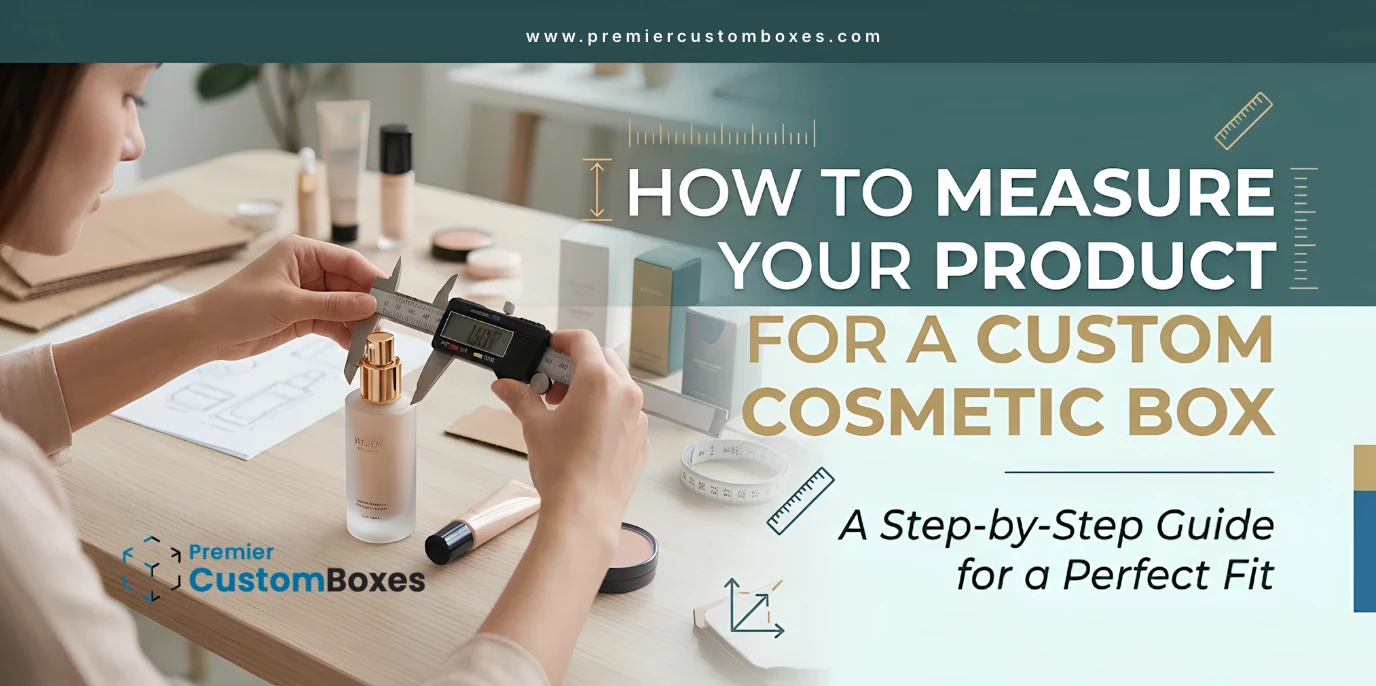
Measure the length, width and height of each item at its widest points, including the cap and pump. A common mistake is measuring the bottle and forgetting the pump head. Our step-by-step guide on how to measure your product for a custom cosmetic box walks you through it.
Check carrier rules first
Creams and lotions can go through the US mail, but only if they're packed properly. USPS Publication 52, section 451 (liquids, creams and pastes) sets the packing rules for nonhazardous liquids, creams and pastes. Read it once before you ship your first order.
Some beauty products count as hazmat (hazardous materials), and those come with extra rules. If you sell anything in an aerosol can, or anything alcohol-based or flammable, check current USPS, UPS and FedEx rules before you ship it. Rules differ by product type, so confirm with each carrier.
How to package skincare products for shipping, step by step
Work from the inside out: seal the product, contain it, wrap it, hold it still, box it, cushion it, then close and label. Skip one step and every step after it has to work harder.
Step 1: Seal every closure
Tighten every cap the same way before it leaves your bench. Torque means how tightly a cap is screwed on. When some caps are tighter than others, some seals hold and some don't.
Next, add a second barrier under or around the lid:
- Inner disc or liner: a small disc under the lid that presses on the jar rim to seal it.
- Induction seal: a foil layer heat-sealed onto the jar mouth under the lid. It's one of the strongest leak barriers you can add.
- Shrink band: a thin plastic ring that shrinks tight around the cap. It also shows whether the lid was opened.
- Tape: a strip over pumps, flip caps and dropper tops keeps them from opening in transit.
Lock every pump. If a pump doesn't lock, tape the head down or put a cap over it. Airless pumps push product up without letting air in, but they still need to be locked for shipping.
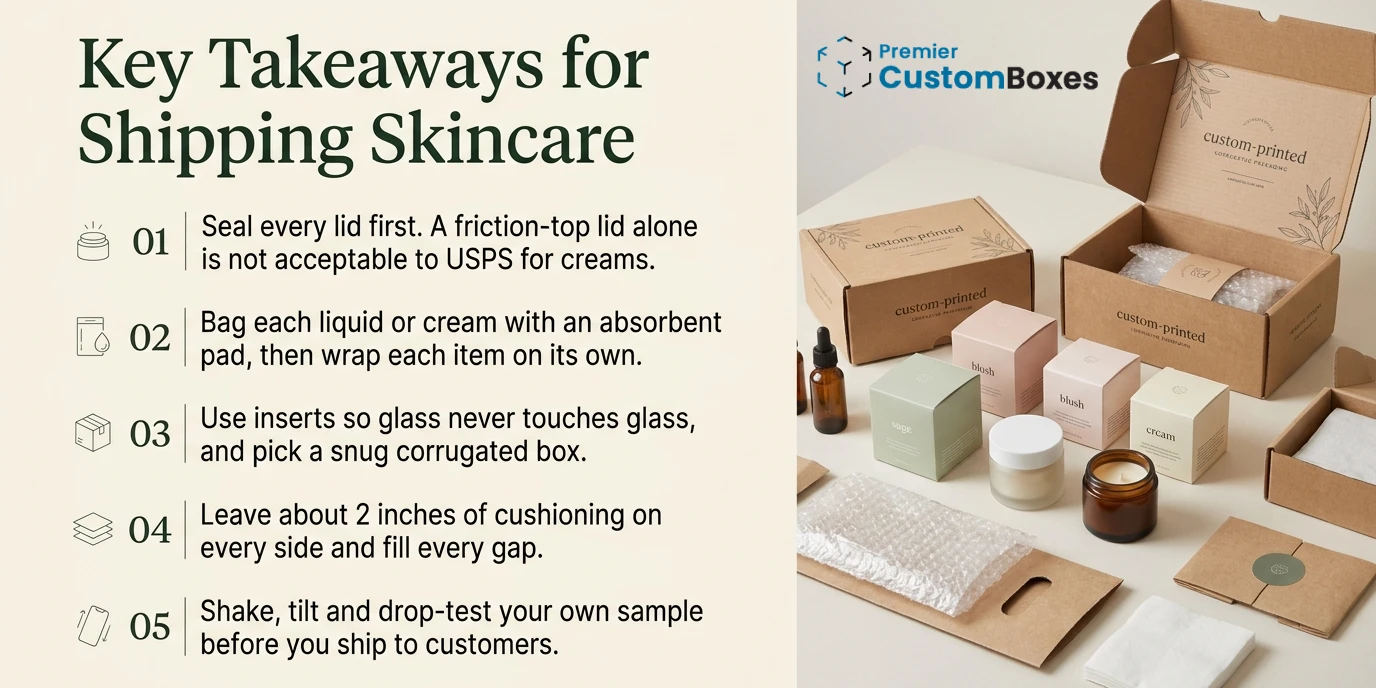
One rule surprises many brands. USPS says containers with friction-top closures alone (push-down lids with no thread) are not acceptable for liquids and creams. They must be packed inside a strong, securely sealed outer package. If your jar has a push-on lid, add a seal and a sealed bag every time.
Step 2: Bag each liquid or cream with an absorbent pad
Put each jar or bottle in its own sealed plastic bag with an absorbent pad. If a seal fails, the mess stays in the bag and the rest of the order stays clean.
This matches carrier guidance. Publication 52 describes leakproof secondary packaging as a watertight can or plastic bag around the container. The UPS packaging guidelines also say to seal bottles and containers in plastic or spill-proof bags. For dry products such as powders, add a desiccant, a small packet that soaks up moisture.
Step 3: Wrap each item on its own
Wrap every item separately, with the bubbles of bubble wrap facing in toward the product. Never wrap two glass items together. Give glass an extra layer around the shoulders and base, where jars tend to crack.
Step 4: Protect glass jars in shipping with inserts
The best way to protect glass jars in shipping is to stop them from moving at all. That's the job of an insert or divider: a shaped piece inside the box that holds each item in place and keeps bottles apart.
Common skincare packaging inserts include:
- Molded pulp: pressed paper fiber shaped into trays or sleeves. It's recyclable and holds bottles snugly.
- Corrugated dividers: cardboard walls that split the box into cells. They work well for kits.
- Foam: soft and protective, with a premium feel.
- Die-cut trays: cardboard cut to the exact shape of your product. "Die cut" means cut with a custom metal blade.
Our view: for repeat orders, a custom-fit insert beats loose bubble wrap. Your team packs every order the same way, it goes faster, and the product sits in the same safe spot each time.
Step 5: Choose a right-size box
Pick a strong corrugated box with just enough room for cushioning, and no more. A bigger box isn't safer. Extra space lets items slide and pick up speed before they hit a wall. A bigger box can also cost more to ship, so ask your carrier how box size affects your rate.
Step 6: Cushion every side and fill the gaps
Leave about 2 inches of cushioning between each item and the box walls. UPS says to surround each item with at least 2 inches of cushioning, keep it at least 2 inches from the walls, and wrap each item separately. The FedEx How to Pack guide also calls for about 2 inches on all six sides.
Then add void fill, the soft material that fills empty space so nothing slides. Kraft paper, air pillows and bubble sheeting all work. Skip newspaper, towels and clothing; UPS guidance lists them as poor cushioning. Close the box loosely and shake it. If anything moves, add more fill.
Step 7: Double-box heavy or fragile glass
Double-boxing (or overboxing) means putting a packed box inside a bigger box with padding between them. Use it for heavy glass jars, large sets and high-value orders. FedEx says the outer box should be at least 6 inches larger than the inner package in length, width and height, with the gaps filled.
FedEx also notes that original product packaging is usually made to ship once, and reusing it weakens it. So a retail carton on its own, or a reused box, isn't a shipping box.
Step 8: Seal and label the package
Close the box with the H-tape method: tape the center seam, then tape across both edge seams so the tape forms an H. Use strong packing tape at least 2 inches wide, as UPS advises. Office tape won't hold.
Put the address label on top of the outer box only. Add "This Side Up" arrows so handlers know which way to stand it. A "Fragile" sticker can help, but don't count on it. Your packing has to do the real work.
Add a tamper-evident seal (a seal that shows if the box was opened) to the inner box. Many brands also use a plain outer shipper, keep product names off the label, and save the branded box for inside. Your customer still gets a great unboxing, and the parcel stays discreet on the porch.
How do you pack face cream for shipping?
Seal the jar, bag it with an absorbent pad, seat it in an insert and box it with cushioning on every side. Here's how that looks for a typical small order.
For example, say a customer orders a small glass eye cream jar and a glass dropper serum from your online store.
- Check that the eye cream jar has an inner disc or induction seal. Tighten the lid and add a shrink band.
- Tighten the dropper, then tape over the top so the bulb can't loosen.
- Put each item in its own zip bag with an absorbent pad, and press the air out.
- Wrap each bagged item separately, with an extra layer around the glass.
- Set both items in a two-cell insert so the glass never touches.
- Place the insert in a snug corrugated mailer or shipper, fill any gaps and shake-test it.
- Seal with the H-tape method and label the top.
Plastic jars are more forgiving than glass, but they still leak. Seal and bag them the same way. You can usually get away with lighter wrap.
Which skincare shipping box should you choose?
For most brands, a corrugated box is the best skincare shipping box because it's strong and light. The right style depends on what you sell and how you want the box to look when it's opened.
A mailer box folds up with a locking lid and ships on its own, so it serves as both the shipper and the branded box. A rigid box is a thick, sturdy box that doesn't fold flat. Brands often use it for luxury gift sets.
| Box type | Best for | Ships on its own? | Watch out for |
|---|---|---|---|
| Corrugated shipper | Glass jars, heavy items, multi-item orders, wholesale | Yes | Plain look unless you print it |
| Corrugated mailer box | DTC orders, subscription boxes, small kits | Yes | Still needs inserts for glass |
| Rigid gift box | Holiday gift sets, premium launches | Usually no; put it in a shipper | Can dent without an outer box |
| Poly mailer (plastic mailing bag) | Soft or unbreakable items only, such as sheet masks or sealed plastic tubes | Yes | No crush protection; not for glass or jars |
A tip that saves time and money: settle on two or three standard pack sizes that cover most of your orders. Packing gets faster, and you can order boxes in bulk in sizes you know will fit.
Which pack-out fits which product?
Each skincare format fails in its own way, so each needs a slightly different fix. Use this table to plan your pack-out by product type.
| Product | Main risk | Seal fix | Insert | Box |
|---|---|---|---|---|
| Glass cream jar | Lid leaks, glass cracks | Inner disc or induction seal, shrink band | Molded pulp or die-cut tray | Corrugated shipper or mailer; double-box if heavy |
| Plastic cream jar | Lid leaks | Inner disc, tape under the lid | Corrugated divider | Corrugated mailer |
| Pump bottle (lotion) | Pump opens or drips | Lock pump, tape the head | Divider cell or foam | Corrugated mailer |
| Glass dropper serum | Dropper loosens, glass breaks | Tighten, tape over top | Molded pulp sleeve | Corrugated shipper or mailer |
| Squeeze tube | Cap pops under pressure | Tighten, tape the flip cap | Optional | Mailer; poly mailer only if alone and sealed |
| Compact or pressed powder | Powder cracks | Seal in a bag with desiccant | Snug foam or tray | Corrugated mailer |
Packing a multi-product kit or gift set
Give each item its own cell, and keep glass away from heavy pieces. Put the heaviest items at the bottom and lighter ones on top. For holiday gift sets, a rigid presentation box inside a corrugated shipper gives you both the look and the protection.
How do you protect skincare from heat and cold?
Ship with the season in mind. When the weather is extreme, add insulation or choose a faster service. Some formulas are sensitive to heat or light and can separate or change texture, so ask your formulator how much heat and cold your products can handle.
- In summer, don't let parcels sit in hot trucks over the weekend. Ship early in the week.
- Use thermal wrap or insulated liners for heat-sensitive formulas.
- Use opaque or tinted containers for light-sensitive products.
- In winter, watch for water-based products that could freeze and separate.
How do you test your packaging before you ship?
Test a real packed sample yourself before anything goes to customers. A few simple tests catch most problems.
- Shake test: close the box and shake it hard. Nothing should move or rattle.
- Tilt test: leave the box on each side, and then upside down, for a while. Open it and look for leaks.
- Drop test: drop the sealed box onto a hard floor from about waist height, on its corners, edges and faces. Open it and check every item.
- Pilot shipment: mail a few packed orders to friends or team members in different states. Ask them for photos when they open the box.
For a formal option, look at ISTA Procedure 3A (via ANSI). It's a lab test that simulates parcel shipping for single packages up to 150 lb (70 kg). It has an optional test that combines vibration with low air pressure, like high altitude, which is useful for checking pressure leaks. Most small brands can start with the home tests above, but ISTA 3A is worth knowing about as you grow.
Following carrier packing guidelines can also help if you ever file a damage claim. Read each carrier's claim terms before you need them.
Common mistakes and fixes
Most broken or leaky orders come from a short list of mistakes. Each one has an easy fix.
| Mistake | Why it fails | Fix |
|---|---|---|
| Box too big | Items slide and hit the walls | Use a right-size box with an insert |
| Push-on lid with no inner seal | Pressure pushes cream out | Add an induction seal or liner and a sealed bag |
| Pumps left unlocked | Pumps get pressed in transit | Lock and tape every pump |
| Loose bottles in a kit | Bottles knock into each other | Use dividers or a die-cut tray |
| Glass touching glass | Small hits crack jars | Wrap separately and use separate cells |
| Newspaper or towels as cushioning | They flatten and give little protection | Use bubble wrap, kraft paper or molded pulp |
| Thin or reused boxes | Weak walls crush | Use new, strong corrugated boxes |
| No sealed bag | One leak ruins the whole order | Bag every liquid or cream with an absorbent pad |
Pro tips from our packaging team
- Write your pack-out as a one-page checklist and tape it to the packing bench. New staff will pack the same way as everyone else.
- Order inserts and boxes together, sized from the same measurements, so they always fit.
- Check closure seals before you fill, not after. A bad batch of lids is cheaper to catch early.
- Put the address label on the outer box only, never on the branded inner box.
- Keep two or three standard box sizes in stock, so nobody grabs whatever box is nearby.
FAQ
How do you ship cream jars without leaking?
Tighten the lid and add an inner disc or induction seal under it. Add a shrink band or tape around the cap. Then put the jar in its own sealed plastic bag with an absorbent pad, so any leak stays in the bag.
Can you mail lotion and face cream with USPS?
Yes. USPS Publication 52 says nonhazardous liquids, creams and pastes can be mailed if they're packed as section 451.3 describes. Containers with friction-top lids alone are not acceptable and must go inside a strong, securely sealed outer package.
How much cushioning do skincare products need?
Plan on about 2 inches on every side. UPS calls for at least 2 inches of cushioning around each item, and FedEx suggests about 2 inches of space on all six sides of the box.
Should you double-box glass skincare?
For heavy glass, large sets and high-value orders, yes. FedEx says the outer box should be at least 6 inches larger than the inner package in length, width and height, with the gaps filled.
Can you ship skincare in a poly mailer?
Only soft or unbreakable items, such as sheet masks or a single sealed plastic tube. Poly mailers give no crush protection, so never use one for glass or jars.
What are the best skincare packaging inserts for glass?
Molded pulp trays, corrugated dividers, foam and die-cut cardboard trays all work. The best one holds each item still and keeps glass from touching glass. For repeat orders, a custom-fit insert is faster to pack than loose wrap.
Can custom packaging cut damage and improve unboxing?
Yes. A box and insert built around your exact product hold it still, need less void fill and look far better when opened than a stock box stuffed with wrap. That's what we do every day at Premier Custom Boxes.
For creams and lotions, our custom cream boxes can be made in any size, style and material, with custom inserts to hold jars in place. Selling a wider line? See our full range of custom cosmetic boxes. You can choose cardboard, kraft, corrugated or rigid stock, and we offer recyclable, biodegradable kraft cardstock made with sustainable raw materials. Our guide to the types of kraft boxes explains the options.
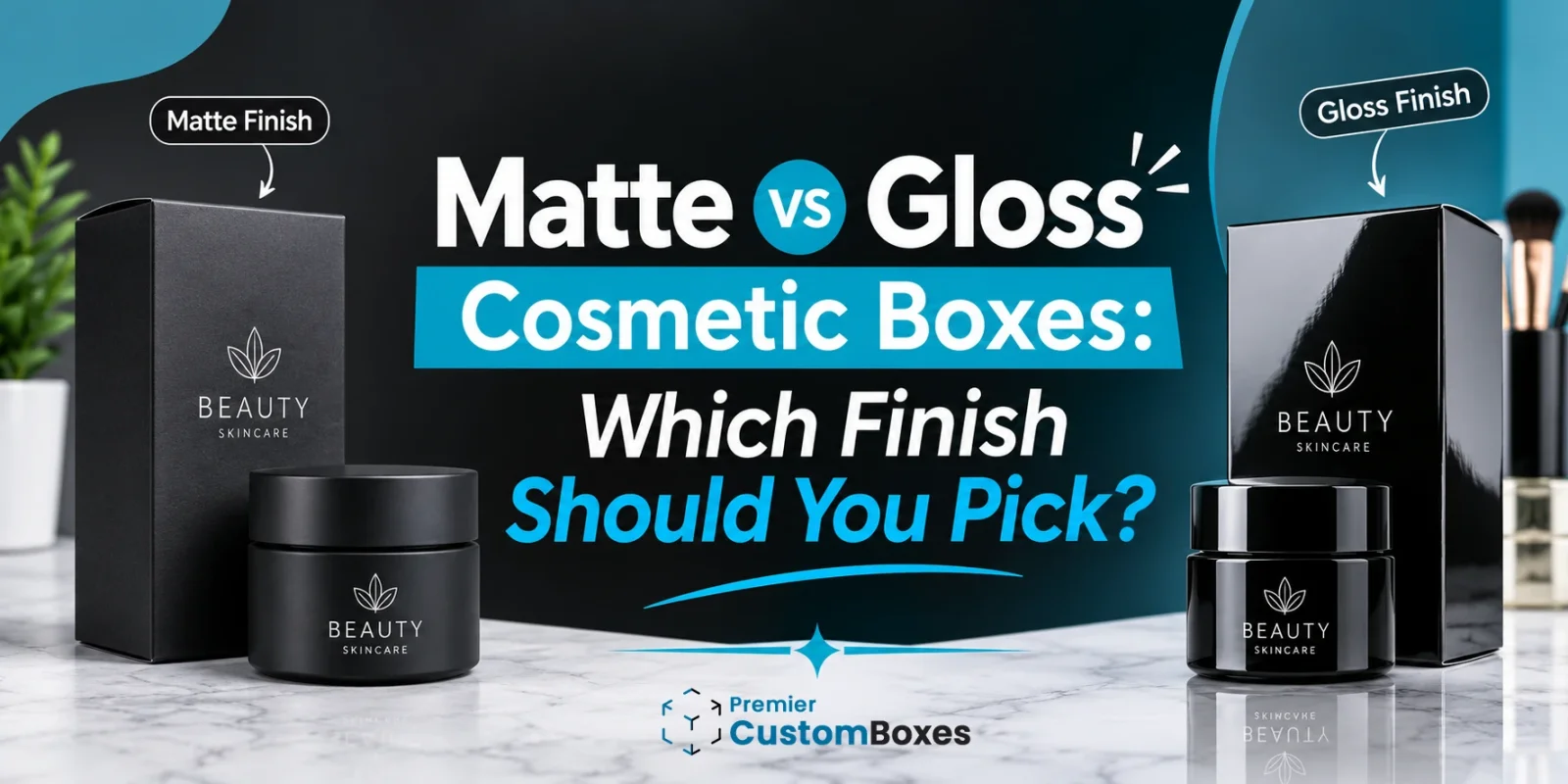
Finishes help your box match your brand. You can choose gloss or matte coating, gold or silver foil stamping, embossing, die-cut windows and QR codes. Spot UV is a shiny coating added only to chosen areas, such as your logo. Not sure which surface suits your look? Read matte vs gloss cosmetic boxes, or see how custom cardboard boxes shape the unboxing moment.
Here's what working with us includes:
- Free design support with unlimited revisions
- Free CAD templates, including dielines (a flat template that shows a box's folds and cuts)
- Free proofing before anything is printed
- Offset and digital printing with four-color CMYK inks (the cyan, magenta, yellow and black inks used in full-color printing)
- A low minimum order of 100 boxes
- Free shipping to all 50 US states
- Standard turnaround of 10–12 business days, or rush service that ships within a week
Ready to pack smarter? Tell us what you sell, your product sizes and how many boxes you need. Our packaging team will help you pick the right style, material, insert and finish, then send you a free mockup and a clear quote. Call (800) 844-1443 in the USA, (02) 7257-6566 in Australia, or email justin@premiercustomboxes.com. Get a Free Quote today.