Last updated: November 2026
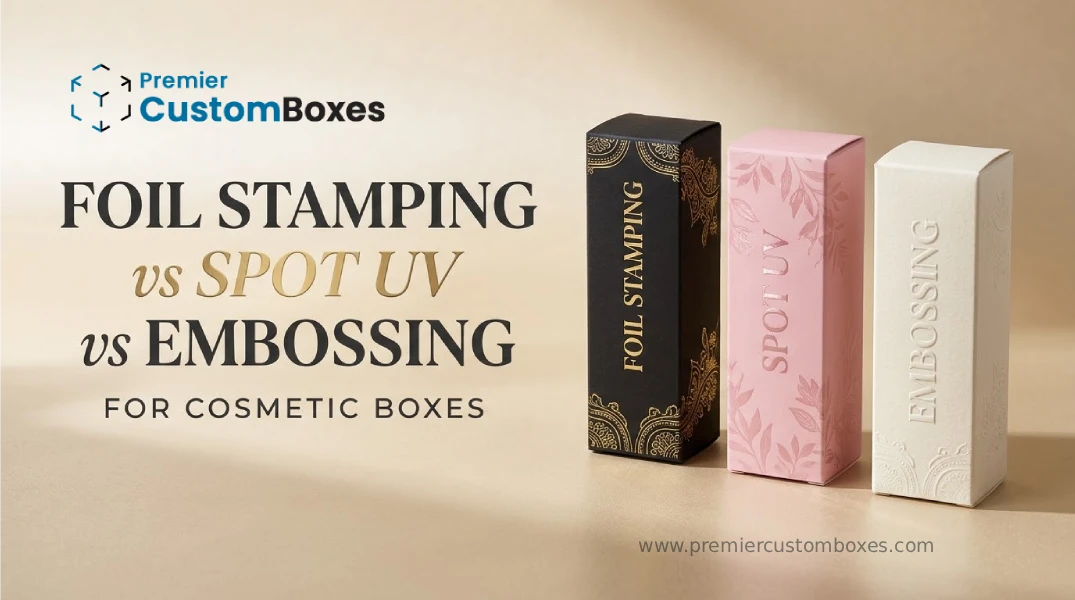
Choose foil stamping when you want your cosmetic box to shine from across a shelf. Choose spot UV for a clean, modern gloss with less setup, and choose embossing when you want shoppers to feel quality in their hands. Your finish shapes how premium the product feels, what you pay for tooling and how well the box holds up on the way to a customer.
Short answer: If you're weighing foil stamping vs spot UV cosmetic boxes, foil wins on shelf impact because it adds real metallic shine. Spot UV adds clear gloss to chosen areas and looks best on matte board. Embossing raises the paper so people can feel it. For many beauty brands, one foil logo plus a quiet spot UV detail works best.
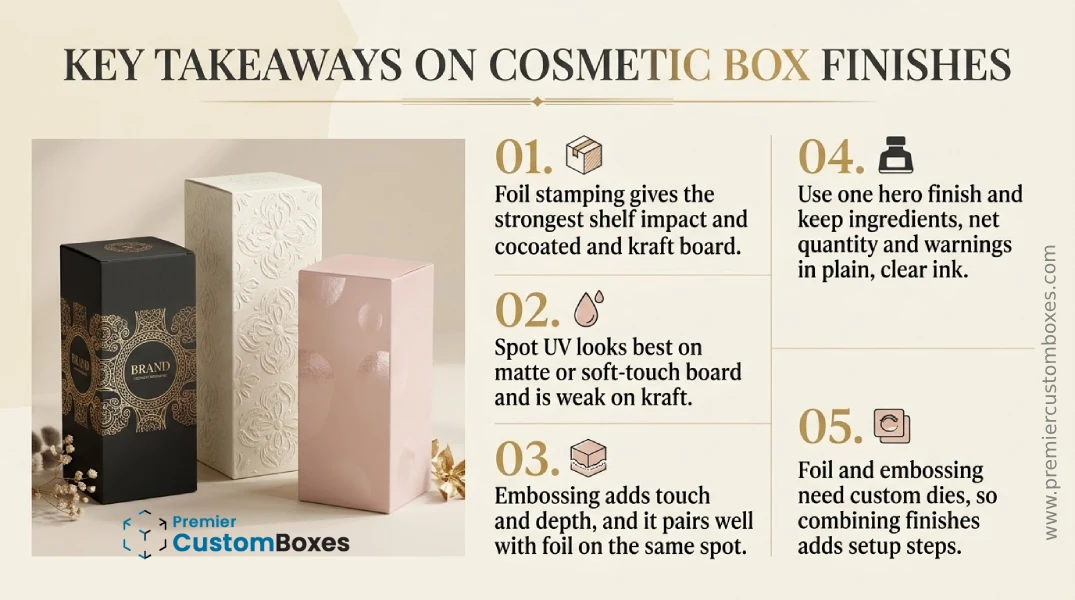
Key takeaways
- Foil stamping is the boldest finish. It reads from a distance and works on most boards, including kraft.
- Spot UV is subtle. It needs a smooth matte or soft-touch base to stand out.
- Embossing adds feel and shadow. Put foil and embossing together and you get a shiny, raised logo.
- Foil and embossing need custom metal dies, so every finish you combine adds setup steps and cost.
- Keep required label text, like ingredients and net quantity, in plain ink on a clear area.
What Is the Difference Between Foil Stamping, Spot UV and Embossing?
Foil stamping adds metallic color, spot UV adds clear shine, and embossing changes the shape of the paper. Each one catches the eye in a different way. Knowing how they're made makes the choice much easier.
Foil stamping: metallic shine from heat and a die
Hot foil stamping uses a heated die. A die is a metal plate with your design cut into it, usually made of magnesium or brass. The press pushes the die onto a thin foil film, and the foil sticks to the box only where your design is. You end up with a logo that looks like real gold, silver or another metal.
- Pros: Strong shelf impact, a true metallic look that ink can't copy, and it works on coated, uncoated and kraft board.
- Cons: It needs a custom die, very fine lines can blur, and large foil areas can scuff if the box ships without an outer mailer.
Spot UV: clear gloss on chosen areas
Spot UV is a clear, glossy coating printed only on the parts of the box you pick. UV light then dries it almost instantly. "Spot" simply means it covers selected spots, not the whole surface. On a matte box, a spot UV logo or pattern catches the light when someone tilts the box, and that gloss-against-matte contrast is the whole effect.
- Pros: A modern, clean look that's good for patterns and large shapes. Digital spot UV needs no physical die.
- Cons: It's subtle from far away, weak on kraft and uncoated board, and hard to see on a box that's already glossy.
Embossing and debossing: shape you can feel
Embossing presses the board so a design rises up. Debossing does the opposite and presses the design down into the board. Both use a matched pair of dies, called a male and female die: one pushes, and the other supports from the back. A blind emboss has no ink or foil at all, only shape and shadow. Foil embossing (also called combo stamping) puts foil and a raised shape in the same spot, so your logo is both shiny and raised.
- Pros: It adds touch, works without any ink, and feels expensive up close.
- Cons: It needs a die pair, board thickness limits fine detail, and the effect is quiet from a distance.
When people ask about embossing vs foil stamping, our rule of thumb is simple. Foil changes the color and shine, while embossing changes the shape. Because they do different jobs, they pair so well.
Foil Stamping vs Spot UV on Cosmetic Boxes: Side-by-Side Table
Foil gives the most visual punch, spot UV gives the cleanest look, and embossing gives the best feel. Here's how the main cosmetic box finishes compare.
| Feature | Foil stamping | Spot UV | Embossing / debossing |
|---|---|---|---|
| Look | Metallic shine (gold, silver and more) | Clear gloss on a matte area | Raised or sunken shape with shadow |
| Feel | Smooth, slightly raised edge | Smooth, slightly slick | Strong texture you can feel |
| Tooling | Custom metal die | Setup and alignment; digital spot UV needs no die | Matched male and female dies |
| Best base | Coated, matte, soft-touch, uncoated or kraft | Matte or soft-touch laminated board | Board thick enough to hold the shape |
| Seen from | Across a shelf | Close up, under angled light | Close up and in the hand |
| Best use | Logos, brand names, borders | Patterns, logos, product shots | Logos, monograms, premium details |
| Watch out for | Fine text filling in, scuffs in shipping | Weak effect on kraft or glossy base | Thin lines that won't hold shape |
Which one costs more to set up?
Foil and embossing usually cost more to set up, because each one needs a custom die. Spot UV still needs setup and careful alignment, but digital spot UV skips the physical die. That's why spot UV can make sense for smaller runs.
We won't quote a fixed price here, and we'd be wary of anyone who does before seeing your artwork. Cost depends on box size, quantity, finish area and how many dies or press passes your design needs. Our guide on what sets the price of custom cosmetic boxes walks through each factor.
Key takeaways on cosmetic box finishes
Which Finish Looks Most Luxurious on Cosmetic Boxes?
Foil embossing usually looks the most luxurious, because it gives you shine and depth in one spot. Still, "luxury" means different things to different brands. A bold makeup line and a quiet clean-beauty line need very different luxury cosmetic box finishes.
Foil for shelf impact
Foil is the finish people notice first. A gold or silver logo catches store lights from across the aisle, so it works hard on a crowded shelf. In our view, it's the safest pick when your box has to sell itself in a store.
Spot UV for a modern, clean look
Spot UV suits minimal skincare and clean-beauty brands. Picture a soft-touch white box with a glossy pattern that only shows when the light hits it. It says "quality" without shouting. For help with the base layer, see our guide to matte vs gloss cosmetic boxes.
Embossing for touch and close-up quality
Embossing pays off the moment a customer picks up the box. For example, a blind-embossed monogram on a rigid box feels calm and expensive. A rigid box is a thick, sturdy gift-style box, often with a lid, and it holds embossed shapes well.
Matching the finish to your product
- Lipstick: The box is small, so keep foil to a short brand name or a simple logo. Tiny foil text on a tiny box is a common cause of blur.
- Perfume: Foil embossing on a rigid or thick box matches the gift feel of fragrance.
- Skincare cream: Soft-touch with spot UV, or a small silver foil logo, keeps the look clean. See our custom cream boxes.
- Lashes: These boxes are often small and handled up close, so embossing or a foil logo both work. See our custom eyelash boxes.
- Hair extensions and nail polish: Bold foil reads well on display, and spot UV patterns can add interest to bright colors.
Can You Use Foil and Spot UV on the Same Box?
Yes, and it's one of the best-looking combinations you can choose. The trick is to give each finish its own job so they don't compete.
Combinations that work
- Matte or soft-touch base + foil logo + spot UV pattern. Matte lamination is a thin, non-shiny film over the whole box. Soft-touch lamination is a matte film with a velvety feel. Both make foil and spot UV stand out.
- Foil-embossed logo + blind emboss pattern. You get shine on the hero element and texture everywhere else.
- Spot UV product image + small foil brand name. This works well when the box shows the product shade.
Order of steps, and why combos add setup
Finishes go on in a set order. The box is printed first, then laminated. Lamination goes on before spot UV so the coating has a stable surface. Embossing usually comes last, so later passes don't flatten the raised shape.
Each finish is a separate pass on a machine, and each one has to line up with the printed art. Printers call this lining up "registration." Poor registration makes a box look sloppy, which is why every added finish adds setup time and cost.
How to avoid a crowded look
Pick one hero finish and let the others play support. If your logo is in foil, skip foil on the tagline, the border and the product name too. For example, a gold foil logo with a soft spot UV pattern behind it looks rich. Add gold borders and gold product text, and the logo gets lost. When everything shines, nothing stands out.
Does the Box Material Change the Result?
Yes, quite a lot. Some finishes need a smooth surface, while others work on almost any board.
Coated board with matte or soft-touch
Coated board is smooth and sealed. Add a matte or soft-touch layer on top, and you have the best base for all three finishes. This is also where spot UV gets the most contrast.
Uncoated, textured and kraft board
Uncoated board has a rougher surface that soaks up coatings. Spot UV looks much weaker on kraft and uncoated stock, so foil is usually the better choice there. Gold foil on brown kraft is a classic look for natural beauty brands. On textured paper, ask for a proof first, because foil may not stick as cleanly to a rough surface.
Be careful on the eco side, too. Foil and UV coatings can make recycling claims harder for a finished box, so we don't claim that every finished box is recyclable. Our recyclable, biodegradable kraft cardstock is a good place to start, and our team can tell you which finishes suit your material.
Rigid boxes
Rigid boxes take foil, embossing and spot UV very well. The wrap paper sits on thick, stable board, which gives every finish a firm base. That makes them a strong choice for a layered, premium look.
How Do Finishes Affect Required Label Information?
Finishes can make required text harder to read, so keep them off your label panel. Use foil and spot UV for your brand, and print required text in plain, high-contrast ink.
The FDA summary of cosmetics labeling requirements says the ingredient list must be conspicuous. In plain words, it must be likely to be read when someone buys the product. These rules apply to the outer container. So for most boxed cosmetics, your box carries the ingredient list and the net quantity. The net quantity goes on the principal display panel, which is the front of the box that shoppers see first.
Shiny foil can glare under store lights, and spot UV over small text can be hard to read at an angle. Our advice is simple: keep ingredients, net quantity, warnings and batch details in plain ink on a clean area. Rules differ by state and product type; check your local regulations. If you sell online, our Amazon cosmetic packaging checklist covers what marketplace sellers should plan for.
How Do You Prepare Artwork for Foil, Spot UV and Embossing?
Put each finish on its own named layer, in vector format, at full size. That way the factory knows exactly where each finish goes.
- Start with the dieline. A dieline is the flat outline of your box, showing every fold and cut. Place all your art on it.
- Use vector files. Vector art (AI, EPS or PDF) stays sharp at any size.
- Make a separate layer for each finish. Give each one a clear name, like "Gold Foil," "Spot UV" or "Emboss." Printers often set these up as spot colors.
- Use solid shapes only for foil. Foil can't reproduce gradients or tints.
- Outline your text. This turns letters into shapes, so the font can't change on another computer.
- Don't add strokes to paths. Turn lines into filled shapes instead.
- Check line widths against the table below.
- Keep finishes away from folds and edges. Foil across a fold can crack. Ask our team about safe spacing for your box style.
| Finish | General minimum line width | Source |
|---|---|---|
| Hot foil on coated paper | 0.1 mm | Printer guidance |
| Hot foil on uncoated or coarse paper | 0.2 mm | Printer guidance |
| Relief embossing lines | 0.3 mm | Tool maker guidance |
| Spacing for reversed-out (knocked-out) text in foil | 0.3 mm | Tool maker guidance |
The foil figures come from these foil and emboss design guidelines from a printer, which also suggest emboss lines about twice the board thickness. The embossing and spacing figures come from a guide on how to prepare files for hot stamping and embossing tools. "Reversed-out" means the letters are left empty and the foil sits around them. Treat these numbers as general guides, not fixed rules. Your factory proof confirms what works on your board.
Our free design support includes unlimited revisions, free CAD templates and a free proof before printing. For a full walk-through, read how to prepare print-ready artwork for cosmetic boxes.
Common Mistakes With Luxury Cosmetic Box Finishes
Most finish problems start with small artwork choices, not with the machine. Here are the ones we'd watch for.
- Thin serif text in foil. Delicate lines can blur or break. Pick a slightly bolder font for foiled words.
- Bold type set too tight. Foil can stick between close lines and fill the gaps, a problem called bridging. Give your letters room.
- Spot UV on kraft or a glossy box. On kraft it soaks in, and on gloss it disappears. Use a matte or soft-touch base instead.
- Too many finishes on different elements. Choose one hero finish and keep the rest quiet.
- Foil across folds or score lines. It may crack when the box is folded.
- Foil or embossing too close to the edge. Small shifts in alignment become easy to see there.
- Forgetting label space. Plan room for required text before you add finishes.
- Shipping a bare foil box. Foil and gloss can scuff in the mail. If you sell on Shopify or Amazon, ship in an outer mailer. Our guide on packaging skincare products for shipping shows how.
How to Choose: Quick Decision Guide
Start with your goal and your board, then pick the finish that fits both. Looked at this way, the spot UV vs foil choice gets much easier.
| If you need... | Best pick | Why |
|---|---|---|
| A logo that pops on a retail shelf | Foil stamping | Metallic shine reads from a distance |
| A minimal, clean-beauty look | Soft-touch + spot UV | Quiet gloss contrast up close |
| A box people want to touch | Embossing or debossing | Texture and shadow you can feel |
| The most premium gift feel | Foil embossing on a rigid box | Shine and depth in one spot |
| A natural or eco look on kraft | Foil or blind emboss | Spot UV is weak on kraft |
| Lower setup on a short run | Digital spot UV | No physical die needed |
| A box that ships bare to customers | Small foil areas, matte base | Less large shiny area to scuff |
No single finish is best for every brand. If you're still unsure, send your artwork to our packaging team. We'll suggest a style, material and finish that fit your product and your budget.
Frequently Asked Questions
Is spot UV cheaper than foil stamping?
Spot UV often costs less to set up, especially digital spot UV, which needs no die. Foil needs a custom die. Your final cost depends on size, quantity and finish area, so a quote is the only reliable answer.
Is spot UV the same as a glossy coating?
No. Spot UV covers only chosen areas, while a gloss coating covers the whole box. Gloss UV and aqueous (AQ) coatings coat the full surface. Spot UV gets its effect from the contrast with the matte areas around it.
What is the difference between embossing and spot UV?
Embossing changes the shape of the board, while spot UV adds clear shine on top. You feel embossing, and you see spot UV when light hits it. Both can be used together on the same design.
Is foil embossing the same as foil stamping?
No. Foil stamping is flat, while foil embossing adds foil and a raised shape in one spot. Foil embossing needs its own custom die and gives a richer, more dimensional logo.
Does spot UV work on kraft or uncoated paper?
It works, but the effect is much weaker because the coating soaks into the rough board. On kraft, foil stamping or a blind emboss usually looks better.
Can I see a proof before printing?
Yes, we provide a free proof before printing. It shows where each finish sits on your dieline, so you can check everything before production. Ask our team if you'd also like to talk about a physical sample.
What is the minimum order for custom cosmetic boxes?
Our minimum order is 100 boxes. Standard turnaround is 10–12 business days, and rush service ships within a week. Startups can learn more in our guide to low minimum custom cosmetic boxes.
Get Your Cosmetic Boxes Finished the Right Way
The right finish fits your brand, your board and the way your box reaches customers. We're happy to help you find it.
We offer gold and silver foil, embossing, debossing, spot UV, soft-touch, die-cut windows, custom inserts and die-cut shapes, with both offset and digital printing. You choose the size, style, material and finish of every box. Each order comes with free design support and unlimited revisions, free shipping to all 50 US states and a low 100-box minimum. Browse our custom cosmetic boxes to see the styles.
Tell us your box size, quantity and style, and our packaging team will send you clear pricing and a free design mockup. Call (800) 844-1443 or email justin@premiercustomboxes.com. Get a free quote today.