Last updated: November 2026
Here's a detail that surprises a lot of new beauty brands. Under FDA rules, ingredient and net quantity labeling applies to the outer container, such as the box. So your box isn't only packaging. It's also part of your label. That's why choosing low minimum custom cosmetic boxes is about more than price. You want a small first order that looks good, fits your product and leaves room for the words you're required to print.
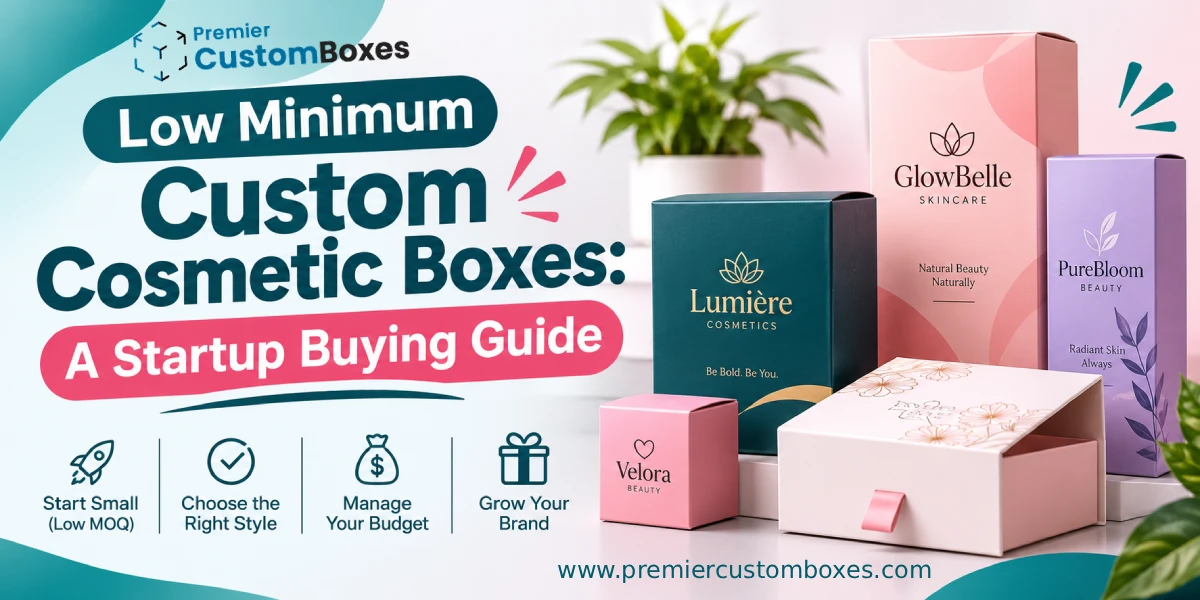
Short answer: A low minimum lets a startup order a small first run of branded boxes instead of thousands. At Premier Custom Boxes, the minimum is 100 boxes, with free design support, free shipping across the USA and a 10–12 business day standard turnaround. Expect a higher price per box on small runs, and plan your label space first.
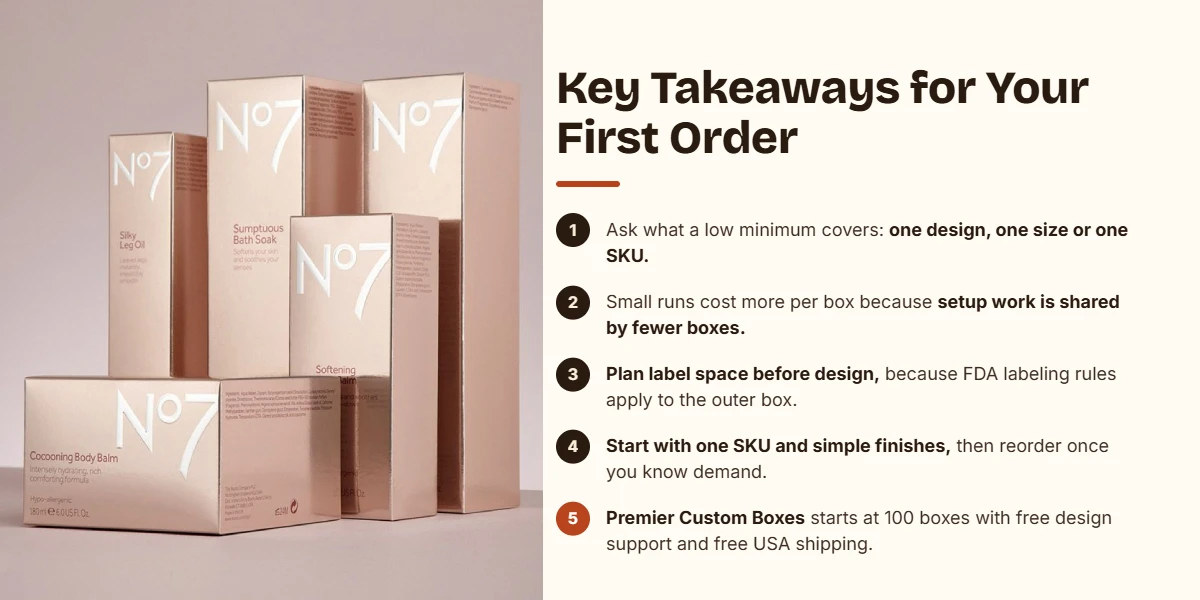
Key takeaways
- "Low minimum" has no standard meaning. Ask what the minimum covers: one design, one size or one product.
- Small runs cost more per box. You pay for setup, and fewer boxes share that cost.
- Plan label space before you design. The front panel and side panels have rules.
- Start with one product and simple finishes. Reorder once you know what sells.
What Counts as a Low Minimum for Custom Cosmetic Boxes?
A low minimum is any order size small enough to test a product without spending a lot up front. There's no industry rule for the exact number. Some suppliers advertise "no minimum," while others start in the thousands.
You'll see the term MOQ a lot. It means minimum order quantity, the smallest number of boxes a printer will make in one order. Our MOQ is 100 boxes. That's enough for a real product launch without filling your garage with stock.
Why do minimums vary so much between suppliers?
It comes down to how the box is made. Simple printed cartons can run in small numbers. Rigid boxes, unusual shapes and heavy finishes need more hand work and setup, so they usually carry higher minimums. Each supplier's machines and printing method also play a part.
Why do small runs cost more per box?
Every order needs setup work, whether you buy 100 boxes or many thousands. Someone prepares the file, sets up the press, makes or loads a cutting die (the metal tool that cuts the box shape) and checks the first sheets. On a big order, many boxes share that work. On a small order, fewer boxes share it, so each one costs more.
That's normal pricing, not a trick. Your total bill for a small run is still lower, and for a startup, that's what matters most.
Is a no-minimum order really possible?
Sometimes, but read the fine print. "No minimum" offers are often limited to a few stock styles, one material or plain finishes. The price per box can also be much higher. If you want a custom size, foil or a rigid box, ask how the offer changes before you commit.
Which Minimum Order Fits Your Stage?
Match your order size to how sure you are about demand. A test launch calls for a small, safe run. A product that already sells well can justify a bigger order with a lower price per box.
| Order size | Price per box | Risk if product changes | Best for |
|---|---|---|---|
| Very small test run (a few dozen) | Highest | Lowest | Samples, photo shoots, influencer kits |
| Starter run (around 100 boxes) | Higher | Low | First launch of one product, online shop or market stall |
| Growth run (several hundred boxes) | Medium | Medium | First retail order, proven best seller |
| Scale-up run (large volume) | Lowest | Highest | Steady sellers with final formulas and final labels |
Very small test run
- Pros: Very little money at stake. Good for checking how the box looks in photos.
- Cons: High price per box. Styles and finishes are often limited.
Starter run of about 100 boxes
- Pros: Enough boxes for a real launch. You still get to choose a custom size, style and finish.
- Cons: The price per box is higher than on large runs.
Growth and scale-up runs
- Pros: Lower price per box. Better suited to retail shelves and steady sales.
- Cons: If your formula, size or label text changes, you could be stuck with boxes you can't use.
Questions to ask about what the minimum covers
The same number can mean very different things. For example, if a minimum applies per design, three lipstick shades with three different designs could mean three separate minimums. Ask these questions before you compare quotes for small order cosmetic packaging:
- Is the minimum per design, per size or per product (SKU)?
- Can I split the order across two or three designs?
- Does the minimum change for rigid boxes, foil or custom inserts?
- Is shipping included, and to which states?
- Do I get a proof before printing?
Key Takeaways for Your First Order
Which Box Style Works Best for Small Batch Cosmetic Packaging?
For most small batch cosmetic packaging, a tuck end box is the safest first pick. It's affordable, ships flat and works for lipstick, cream, serum and lip balm. Rigid boxes look more premium, but they cost more and take up more storage space.
A tuck end box (also called a folding carton) is a paperboard box with flaps that tuck in to close. A rigid box is made from thick, sturdy board and doesn't fold flat, so it arrives already built.
| Style | What it is | Cost level | Best for |
|---|---|---|---|
| Tuck end box | Folding carton with tuck-in flaps | Low | Lipstick, lip balm, mascara, cream jars, serums |
| Sleeve box | A tray that slides out of an outer sleeve | Medium | Lashes, palettes, small gift sets |
| Mailer box | Folding box with a lid, often corrugated | Medium | Subscription boxes, online orders, skincare sets |
| Rigid box | Thick board box that keeps its shape | High | Perfume, luxury sets, holiday gifts |
| Display box | Open box that sits on a counter | Medium | Lip balms or nail polish at a checkout counter |
Matching style to your product
Lipstick and lip balm fit well in slim tuck end boxes. Cream jars and serum bottles also suit tuck end boxes, often with an insert, which is a piece inside that holds the product still. See our custom cream boxes for jar and tube ideas.
Lashes look great in sleeve boxes or small boxes with a die-cut window, a cut-out that lets shoppers see the product. Our custom eyelash boxes page shows these styles. Perfume is where a rigid box often makes sense. We'd suggest waiting until you know the scent sells.
Which Material Should a Startup Choose?
White cardstock is the best all-round choice for most cosmetic boxes for startups. It prints colors cleanly and costs less than rigid board. Kraft suits natural brands, corrugated handles shipping, and rigid board fits luxury products.
| Material | Look and feel | Cost level | Best for |
|---|---|---|---|
| White cardstock | Smooth, bright, sharp print | Low | Most retail cosmetics |
| Kraft | Brown, natural, earthy | Low | Clean beauty, soaps, handmade lines |
| Corrugated | Strong, with a wavy inner layer | Medium | Mailers and online orders |
| Rigid (chipboard) | Thick, heavy, premium | High | Perfume and gift sets |
What does pt thickness mean?
Point (pt) measures how thick paperboard is. A higher pt means a thicker, stiffer box. A heavy glass bottle needs thicker board than a light lip balm tube. You may also see GSM, short for grams per square meter. It measures paper weight and is often used for kraft. If you're not sure what you need, our packaging team can suggest a thickness based on your product's weight.
Is there an eco-friendly option?
Yes. We offer recyclable, biodegradable kraft cardstock made with sustainable raw materials. You can read about the types of kraft boxes before you decide.
Which Finishes Are Worth It on a Small Order?
On a small order, pick one standout finish instead of three. A matte or gloss coating plus one accent, like foil on the logo, gives a premium look without stacking up setup costs.
- Matte coating: a flat, soft surface. It feels calm and modern.
- Gloss coating: a shiny surface that makes colors look brighter.
- Soft-touch coating: a matte coating that feels velvety in the hand.
- Spot UV: a shiny clear coating on certain spots only, such as your logo.
- Foil stamping: a thin gold or silver film pressed onto the box.
- Embossing and debossing: pressing a shape so it rises (emboss) or sinks (deboss).
- Die-cut window: a cut-out so shoppers can see the product.
Each extra finish can add a step, a tool or more press time, so it changes the cost as well as the look. Coatings come free with our boxes, which makes a matte or gloss surface a simple choice. To compare the two, see our guide on matte vs gloss cosmetic boxes.
Custom cosmetic boxes with logo: where should it go?
Put your logo on the front panel, where shoppers look first, and make it large enough to read from a shelf. Just don't let it push required text into a corner. On a small box, a second logo on the top flap is a nice touch for online orders.
Digital or offset printing?
Digital printing prints straight from a file, a bit like a large office printer. It suits small runs and quick design changes. Offset printing transfers ink from metal plates onto the board, giving very even color on bigger runs. Both usually use CMYK, which mixes four inks (cyan, magenta, yellow and black) to make most colors. If you need an exact brand color, you may hear about PMS (Pantone), a system of named ink colors. Ask our team which method fits your order.
What Must Be Printed on a Cosmetic Box?
The front of the box must show the product name, what it is or does, and how much is inside. Other panels carry the ingredients and your company name and address. Plan this space before anyone starts the design, because fitting it in later is where costly reprints begin.
Front panel (PDP) and information panel
The principal display panel (PDP) is the front panel shoppers see first. According to the FDA summary of cosmetics labeling requirements, it must state the product name, the nature or use of the product, and the net quantity of contents (how much is inside, such as weight or fluid ounces).
The information panel is another side of the box, and your company name and place of business go there. The FDA also says the ingredient list may go on any information panel, including the folding carton. Ingredients are listed by their INCI names, which are standard names used across the industry.
What about very small boxes?
Lip balm and lash boxes often have a tiny front panel. Under 21 CFR Part 701 cosmetic labeling rules, if the PDP is 5 square inches or less, the net quantity type must be at least 1/16 inch high. The same rules say that if a box has more than one front-facing panel, the required front panel information must appear on each one. On a small box, that uses up space quickly, so measure early.
MoCRA and the contact on your box
MoCRA (the Modernization of Cosmetics Regulation Act) is a US law that added new FDA rules for cosmetics. One change affects your box directly. Labels now need a US contact, such as a domestic address, phone number or electronic contact, so people can report problems.
The responsible person is the company that answers for the product, usually your brand. According to the FDA page on reporting cosmetic complaints, that company must report serious adverse events to the FDA within 15 business days. The report must include a copy of the label on or within the retail packaging.
MoCRA has a small business exemption, but it covers things like facility registration and product listing. It doesn't remove labeling duties, and some products, such as eye-area items like mascara, may not qualify. FDA rules on fragrance allergen labeling are also still in progress. Leaving a little spare room on your panels now could save you a redesign later.
Privacy tip: this contact gets printed on a public box. Use a business email, phone number or website, not your home address or personal cell.
Rules differ by state and product type; check your local regulations. We design boxes with space for required labels, but your brand is responsible for the label content.
How Do You Order Custom Cosmetic Boxes for a Small Business?
Ordering takes five steps: measure, choose, design, approve and produce. Most of the risk sits in the first and fourth steps, so slow down there.
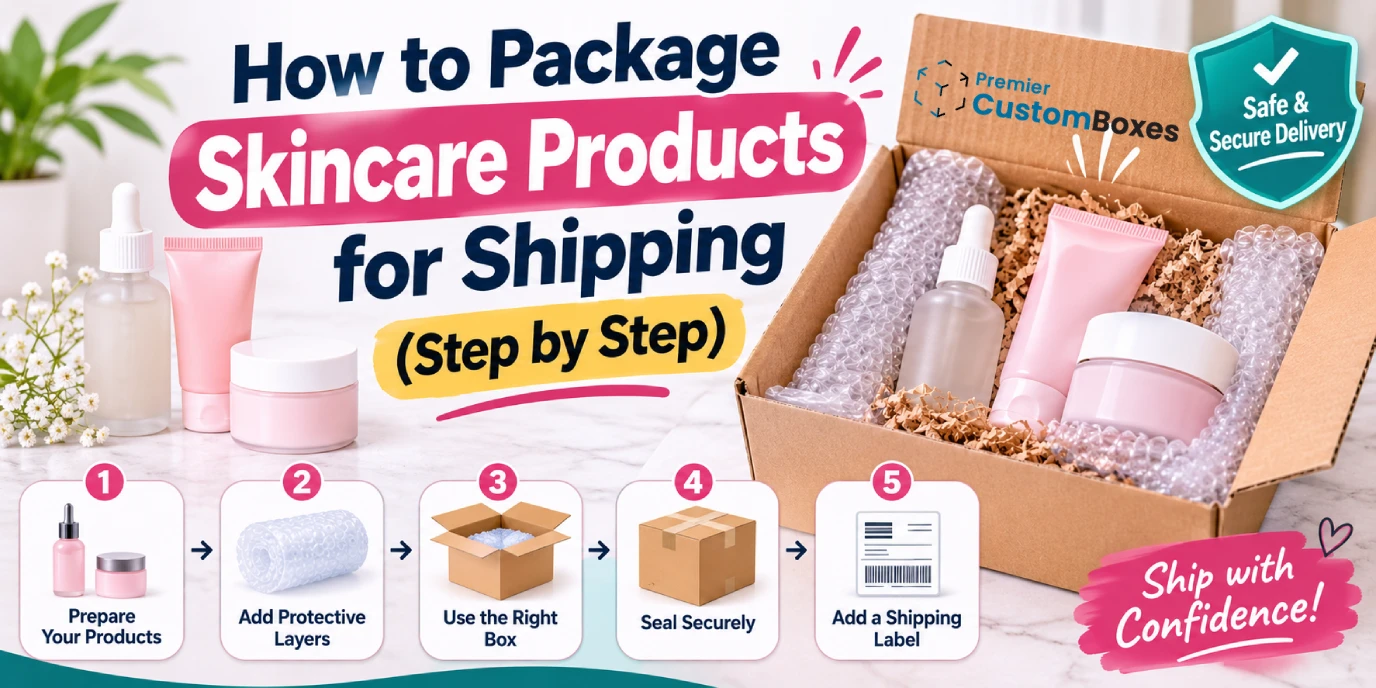
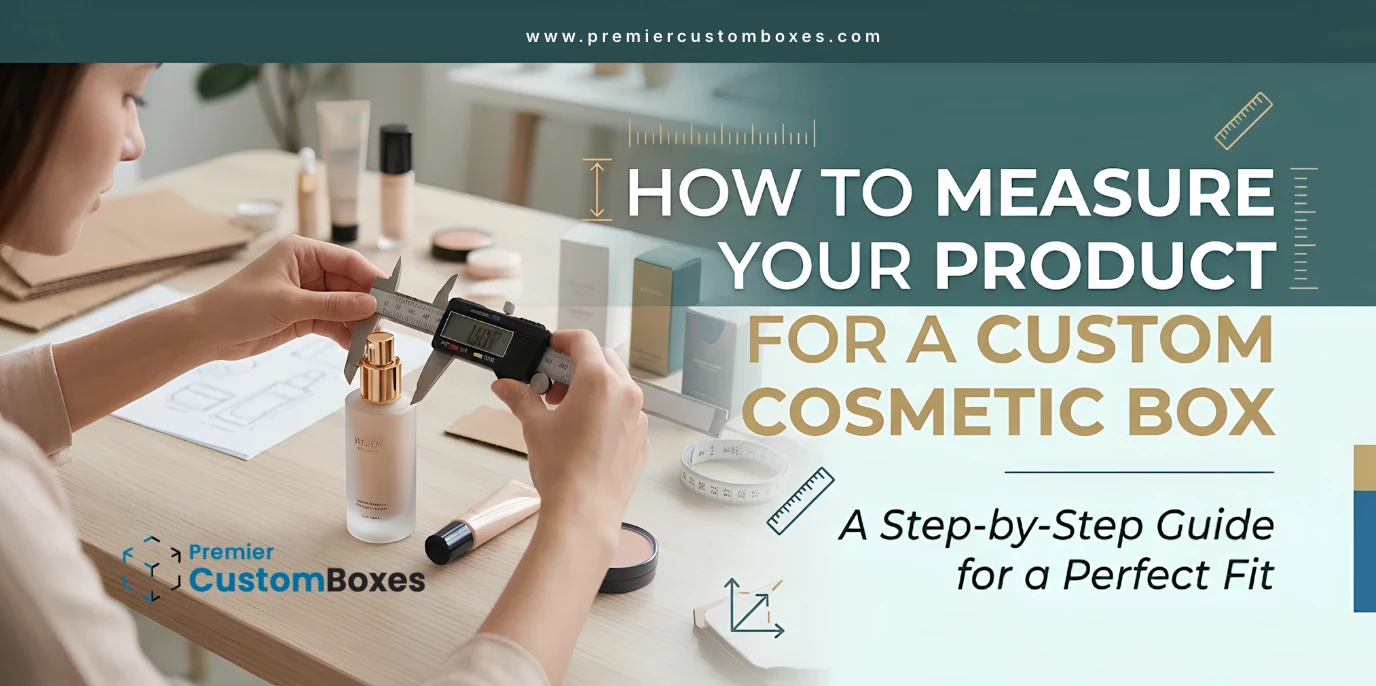
- Measure the product. Measure the actual container, not the size on your formula sheet. Include any cap, pump or insert. Our guide on how to measure your product for a custom cosmetic box walks you through it.
- Pick style, material and finish. Use the tables above, or ask our packaging team for a suggestion.
- Get the dieline and a mockup. A dieline is a flat drawing of the box that shows fold and cut lines. Your artwork goes on top of it. We provide free CAD templates and free design support with unlimited revisions.
- Approve the proof. A proof is a preview of the final box, and ours is free. Check every word, color and fold before you say yes.
- Production and shipping. Standard turnaround is 10–12 business days, and rush service ships within a week. Shipping is free to all 50 states.
One more point on shipping costs. Many carriers use dimensional-weight pricing, which means the price depends on box size, not just weight. A right-sized box can lower what you pay each time you mail an order to a customer.
Which Option Should You Choose?
Choose the simplest box that protects your product and holds your label text. Premium touches can always come with the reorder.
- If you're launching one lip balm shade, pick a white cardstock tuck end box with a gloss or matte coating.
- If you sell a serum set on Shopify, pick a corrugated mailer with a custom insert so bottles don't shift in transit.
- If you sell lashes in several lengths, use one dieline for all of them and change only a color band or a small sticker label.
- If you sell soap and lotion at a farmers market, kraft boxes match a handmade look and are simple to print.
- If you're launching a perfume, consider a rigid box, but test demand with a smaller run first.
Common Mistakes Startups Make With Small Orders
The most expensive mistakes happen before printing, not after. A careful check of size, text and files can save you a full reprint.
- Guessing the box size. A box that's too loose lets products rattle. One that's too tight won't close.
- No room for label text. The design fills every panel, and the ingredient list ends up tiny or missing.
- Wrong color mode or low-quality images. Art made in RGB (screen colors) can look different when printed in CMYK. Low-resolution images print blurry.
- Text in the fold or glue area. Words placed on a fold line can crack or get hidden.
- Ordering too much too soon. A large run of luxury boxes before you know demand leaves your money sitting in storage.
- Skipping a careful proof check. Approving in a rush is one of the easiest ways to end up with an avoidable error.
How Premier Custom Boxes Helps Small Brands
We make custom cosmetic boxes for small business owners with a 100-box minimum, so you can launch without a big stockpile. You get the same custom options as a larger order, with our team helping at every step.
- Minimum order of 100 boxes
- Free design support with unlimited revisions
- Free proofing, free coatings and free CAD templates
- Free shipping to all 50 states
- Any size, shape and material on request
- Finishes such as foil stamping, embossing, spot UV, gloss and matte coatings, die-cut windows and custom inserts
Browse our custom cosmetic boxes to see styles for lipstick, cream, foundation, lashes and more. If you're unsure which style, material or finish fits, our packaging team will help you choose.
Frequently Asked Questions
What is the minimum order for custom cosmetic boxes?
At Premier Custom Boxes, the minimum order is 100 boxes. Across the market, minimums vary a lot, so always ask whether a minimum is per design, per size or per product.
How much do custom cosmetic boxes cost?
The price depends on size, style, material, finish and quantity. Rigid boxes and extra finishes cost more than simple cardstock boxes. Request a free quote with your box details for exact pricing.
Why do small orders cost more per box?
Setup work is shared by fewer boxes. File prep, press setup and cutting tools take about the same effort for a small run as a big one, so each box carries more of that cost.
Can I order custom cosmetic boxes with my logo in small quantities?
Yes. You can print your logo on orders starting at 100 boxes, in the style, size and finish you choose. Our free design support can help you place the logo and lay out the panels.
How long does it take to make custom cosmetic boxes?
Standard turnaround is 10–12 business days. If you're short on time, rush service ships within a week.
What material is best for cosmetic boxes?
White cardstock is the best fit for most cosmetic boxes. Choose kraft for a natural look, corrugated for shipping strength, and rigid board for luxury items like perfume.
Do I need an FDA-compliant label on my box?
FDA labeling rules apply to the outer box, so the box needs the required label information. That includes the product name, what the product is, net quantity, ingredients and company details. Rules differ by state and product type; check your local regulations, and ask a regulatory expert if you're unsure.
Ready to Order Your First Small Run?
A safe first order is small, simple and planned around your label. Start with one product, one strong finish and a box that fits your container well. Once you see what your customers buy, you can reorder with confidence.
Want boxes that fit your product and your launch budget? Get a free quote from Premier Custom Boxes. Tell us your box size, quantity and style, and our packaging team will send you pricing and a free design mockup. Call (800) 844-1443 or email justin@premiercustomboxes.com. Request your free quote today.